Read the HTML statement
Visitor-friendly version with publication boundary, proof stack, and related accountability pages.
No private case intake: do not send child names, sealed records, private allegations, or confidential files through public campaign links. Privacy boundarySafety first
Site boundary: JTforME is the campaign, public-record, citizen-initiative, and Maine family-help routing hub. For volunteer-only public education, printable tools, and research/source materials, use FOCaF.
This campaign is not asking people to trust rhetoric. It is showing the public record: family backlog, staffing need, southern Maine court pressure, housing instability, and child-impact research.
I want this page to work like an evidence center: claim, visual, source, method, then the official record.
Read the Initiative Download source index CSV Review checklist PDF July 8 court letter Briefs + data
The matrix is the cleanest entry point for skeptical readers because it separates what the record anchors, what the law requires, what the research supports, and what remains opinion or public-policy argument.
public release adds formal claim maps to the Bedard and Lucy accountability pages and a claim-to-citation map to the citation bank. The purpose is to separate record facts, legal duties, official data, clinical research, opinion, and correction pathways.
This source layer collects copy-ready in-text citations for Maine constitutional delay, judicial diligence, Rule 3.3 candor, records access, child contact, interparental conflict research, ACEs, toxic stress, parental alienating behaviors, and father involvement.
This source card links the long-form public statement, the original uploaded DOCX, the accountability pages it supports, and the research/legal source categories used to strengthen the argument.
Visitor-friendly version with publication boundary, proof stack, and related accountability pages.
Original uploaded long-form public accountability statement preserved as a source artifact.
Maine professional conduct, judicial conduct, and best-interest rules provide the public-accountability framework.
CDC, NLM/PMC, PubMed, and Judicial Branch statewide data strengthen the child-impact and public-system lanes.
Use it when the job is verifying the charts, tracing the claim, or moving from argument back into the record.
This page is for the receipts layer: methodology, source trail, and the links that let scrutiny happen without hunting.
Use it when someone needs to test a number, inspect a chart source, or follow a claim back to the originating material.
If the reader needs the public case in one cleaner page first, the flagship dashboard should take over.
This page should feed into briefs, packets, or the dashboard once the exact source question is answered.
The proof lane works best when readers move through it in a steady sequence: name the claim, check the source label, read the method and limit, compare the response, then carry the right proof artifact out of the page.
Use the crosswalk or matrix to identify the exact statement under review.
Official record, public data, research, and reading-note material should not all be treated as the same thing.
Method and scope notes are part of the proof, not a footnote to ignore after a chart lands.
Proof should hand into a real response path instead of drifting into accusation without architecture.
Use fast-reads, briefs, or proof packs when the full evidence page is more than the moment requires.
These nearby pages keep the public record, source trail, and measurement layer close together.
Read the flagship public-record page when you need the campaign case in one place.
Open State of Maine FamiliesUse the chart packets, CSVs, and concise issue framing.
Open Briefs + dataFollow what is proposed, what is measured, and what still needs to move.
Open Reform TrackerUse the standard-setting page when the question is what a fix should be judged against.
Open StandardsThis filing ties the child-impact record to court correction, public-official review, Judicial Branch review, professional-responsibility concerns, Glenn Anderson witness context, and the need to stop treating implementation failure as ordinary docket drift.
If child-access pressure, family-court pressure, or fear for safety is making today feel dangerous or unbearable, start with crisis support, counseling, and the cleanest Maine justice doors first.
Annual reports, regional caseload reports, and the workload study from the Maine Judicial Branch.
MaineHousing research, the Point in Time report, and federal vacancy data used with clear limits stated on-page.
Public child and housing indicators that help show pressure without pretending to explain everything.
Named public-health and family-law reviews that help explain why delay, conflict, and instability matter for children.
Use this page as the campaign’s receipt book. The quick charts are local visualizations built from public sources. Each source card links out to the official record.
This page is strongest when every proof block answers four questions cleanly: what is the claim, what does the visual show, what is the source, and what public response is supposed to follow from it.
Each major argument should be specific enough that a skeptical reader knows exactly what to verify or reject.
The visual should make the pressure legible without pretending to prove more than the underlying source can support.
Readers should be able to tell whether the source is a court report, workload study, housing research, federal data point, or child-impact research item.
The evidence center should not stop at diagnosis. It should connect the record to the reform standard and the measurement layer.
I would rather show what a chart does not prove than overclaim it. That is how the site stays more disciplined than a normal campaign page.
A stronger evidence center does not just list links. It tells people whether the item is an official annual report, a workload or caseload record, a housing or federal data point, or research used to explain child impact and systems pressure.
Annual reports, published court hubs, and named state records are where the flagship counts and backlog language should start.
These sources help show why the site keeps returning to staffing need, Biddeford and Portland pressure, and visible court load.
Housing belongs here as supporting context, not as a substitute for the family-court record the page is primarily about.
The research layer helps connect administrative drift to child distress and family harm without pretending that one article proves the whole reform case.
The evidence center is built so skeptical readers, officials, and press can challenge a claim without getting lost. Start with the exact claim, check what kind of record is being used, read the method note, then go to the source itself.
That keeps criticism pointed at the real claim instead of a vague feeling about the page.
Readers should know whether they are looking at an official record, public data point, research item, or a reading note.
The page is stronger when it states what a figure does not prove as plainly as what it does.
Sometimes the fair next move is a cleaner public page or a packet, not the whole receipt wall at once.
| Campaign claim | Proof anchor | Why it matters |
|---|---|---|
| Family-court delay is a real, measurable public issue. | Backlog chart and 2025 annual report | It grounds the campaign in a public record, not private grievance alone. |
| Capacity pressure is part of the story. | Workload-study capacity chart | Reform arguments are stronger when staffing and resource constraints are acknowledged. |
| Southern Maine families are under multiple pressures at once. | Regional pressure section | It shows why the site includes housing only where it clearly helps explain family instability. |
| Delay and instability affect children, not just calendars. | Child-impact research | It provides a research-based bridge between system drift and family harm. |
For avoidance of doubt, this public-review work may identify public officials, court personnel, agency personnel, and publicly compensated actors by name and title where their actions appear in court records, docket entries, official correspondence, public filings, or other record-supported materials.
Any such references will be made for purposes of accuracy, source attribution, public accountability, and institutional reform. They are not intended as personal attacks. Where a statement concerns disputed facts, the statement should identify the facts as disputed. Where a statement concerns a filed document, order, docket event, or official communication, the statement should describe it by date, role, and record source.
The point is not personality. The point is that children and families experience institutional harm through identifiable decisions, omissions, delays, procedural barriers, and implementation failures. Public accountability requires enough specificity that the pattern can be audited rather than dismissed as a generalized complaint.
This page becomes harder to criticize when the most important proof lanes have a clean crosswalk. The point is not to overwhelm people with links. It is to show exactly how a public claim moves into a visual, how the visual rests on named records, and what kind of reform or public-use packet is supposed to follow from that record.
The backlog chart, capacity chart, annual report, and workload study belong together because they answer the baseline question before anyone starts arguing over theory.
This is where the site shows why Biddeford, Portland, and the southern corridor keep appearing in the public case without pretending the map or the chart proves every cause by itself.
Housing, PIT, and child-impact research belong here as disciplined supporting context for family strain, not as a substitute for the family-court record.
The proof layer should not stop at diagnosis. It should move into the family platform, the tracker, the standards, or the protected initiative materials depending on how specific the question becomes.
Different readers should not have to reverse-engineer how to use this page. These routes keep the evidence center disciplined and portable instead of leaving people to improvise with screenshots.
Use the claim matrix, source index, and review checklist to move from assertion to chart to official record without relying on my framing.
Use the dashboard, initiative, findings appendix, and this source layer together when the work needs to read like a public record rather than a campaign brochure.
The safest share path is flagship page first, short brief second, then the voter-language layer after the core record is clear.
When the immediate problem is a hearing, housing strain, safety, or child support, use the evidence layer after the practical next step is already in motion.
I do not want this page used like a mood board. The point is to make the chain visible: official record, visual extraction, public explanation, then the reform text that claims to answer it.
Start with the annual report, workload study, regional caseload reports, MaineHousing work, and child-impact research.
The visuals are there to clarify the public record, not replace it. Read the captions and method notes with the charts.
When someone needs a shorter packet, use the briefs and source index rather than screenshot fragments or vague summaries.
The initiative should be pressure-tested after the public record is clear enough to evaluate whether the reform claim actually fits the problem.
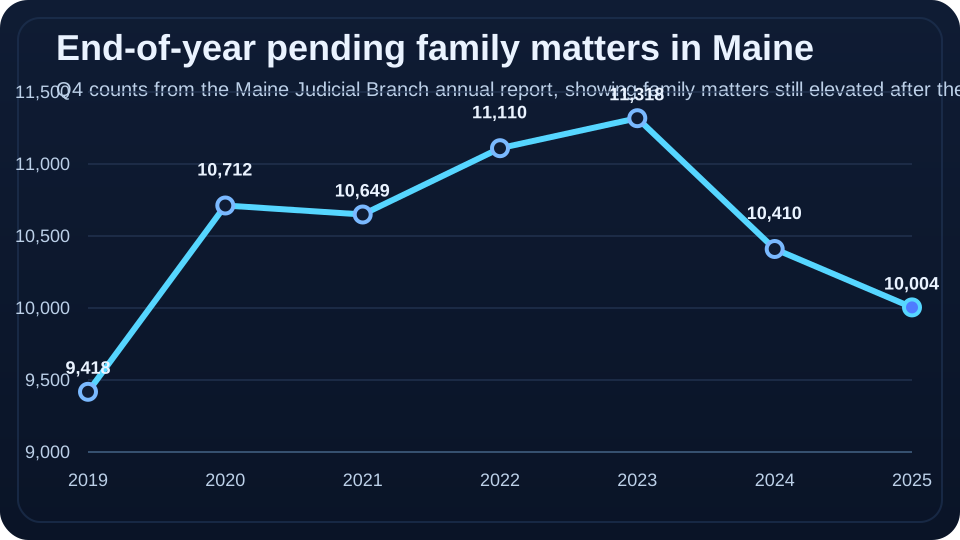
The 2025 annual report says family matters improved in 2025 but remained around 8% above the 2019 average.
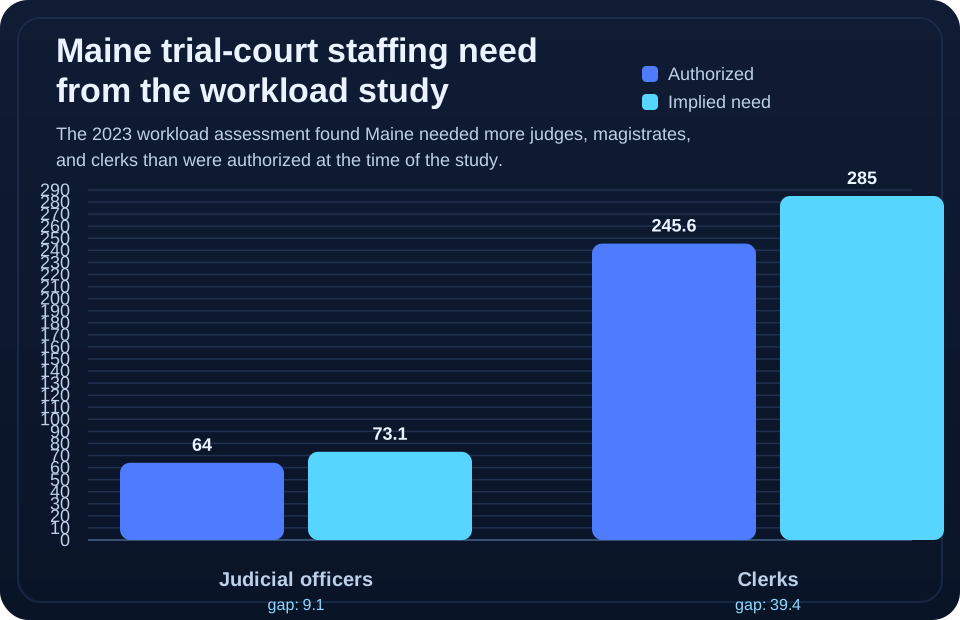
The workload study is one of the clearest pieces of evidence that this is not just a rhetorical complaint about courts. Maine’s own system study identified staffing gaps.
The annual report is the main source for statewide family backlog language and the pending family matters trend used on this site.
This study is the core source for judicial-officer and clerk staffing need. It found need for 73.1 judicial officers and 285 clerks statewide, compared with 64 authorized judicial officers and 245.6 FTE clerks at the time.
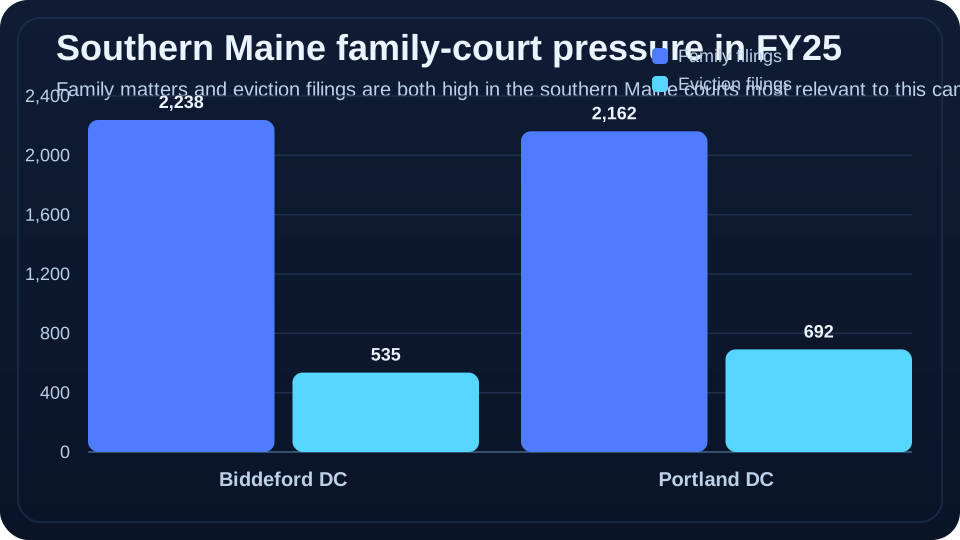
The chart does not say evictions cause every family matter or that every family matter is housing-driven. It shows that the courts serving southern Maine families are handling major family caseloads and hundreds of eviction filings at the same time.
That is enough to justify talking about housing in family terms: stability, child time, and preventable escalation.
Includes York County Superior Court and Biddeford District Court. The FY25 table lists Biddeford District Court with 2,238 family filings and 535 forcible entry (eviction) filings.
Includes Cumberland County Superior Court and Portland District Court. The FY25 table lists Portland District Court with 2,162 family filings and 692 forcible entry (eviction) filings.
MaineHousing’s housing needs study estimates that Maine needs approximately 76,400 to 84,300 homes by 2030 and says the coastal region has the largest share of need.
The 2026 outlook provides the eviction series, development-cost trend, and broader housing-market context used in the visual proof system.
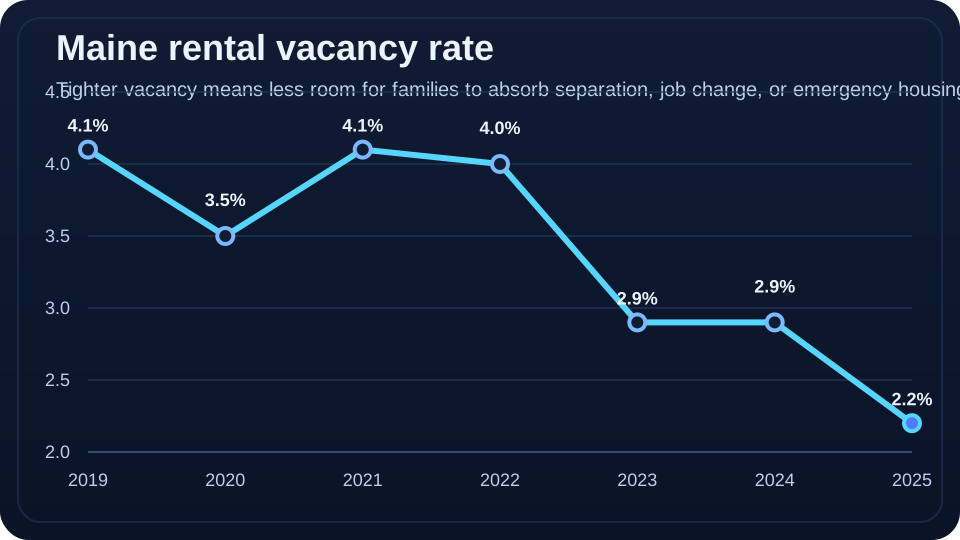
FRED shows Maine’s annual rental vacancy rate at 4.1% in 2019 and 2.2% in 2025.
The report notes the Point in Time count is a limited single-night snapshot. Even with that caution, it still reports that 14.9% of households experiencing homelessness had at least one child.
This PubMed Central article includes a stark line worth keeping in plain view: prolonged and angry legal fights are a major indicator of severe distress for children involved.
This review is useful for nuance: child outcomes are shaped by conflict, resources, and stability, not by simplistic talking points. That is exactly why family-process reform and family stability both matter.
The latest federal child well-being indicator reports that 39% of households with children ages 0–17 reported housing cost burden, crowding, and/or physically inadequate housing in 2021.
Maine’s own family-well-being framing emphasizes keeping children safe by keeping families strong, improving access to support early, and strengthening concrete supports for parents and caregivers.
This evidence center should make challenge possible without rewarding lazy challenge. The fair questions are: what does this claim actually say, what source carries it, what does the visual add, and where should a serious reader go next if they still doubt it?
It can show the burden Maine families are carrying, where the numbers come from, and how the reform response is being tied back to the public record.
Not every chart proves causation, and not every claim can be settled by one visual. The site should say that plainly so the standard stays disciplined.
If a reader thinks the page overstates something, the next move should be the source card or original document, not a screenshot argument detached from context.
Use a brief, a record pack, or the flagship page depending on the job. Do not force every reader through the whole evidence shelf when one disciplined handoff will do.
The site prefers official reports, public dashboards, legislative records, and named research sources over commentary.
Housing, court strain, and child-impact research are connected carefully. The page states plainly what the charts do and do not claim.
Every chart is intended to help a visitor understand a public record faster, not to overpower the argument with graphics.
The page routes people more quickly from headline claims to proof anchors, source cards, and official documents.
Caseload statistics, regional reports, annual reports, and eviction-filing trends.
Housing needs study, 2026 outlook, and the Point in Time report used throughout this proof layer.
Federal child well-being indicators plus peer-reviewed public-health and family-law literature.
I want people to be able to move in both directions: from a chart back to the source, and from the draft back to the evidence it is trying to answer. That is part of how this site stays serious.
The initiative page keeps the draft text intact and labels the non-statutory material separately.
This is where the rationale, pressure points, and transparency frame are easier to review without muddying the bill text itself.
The plain-language materials now have their own downloads so people do not have to clip pieces out of a long page.
The draft should be easier to scrutinize than a normal campaign promise, not harder.
I want the proof layer to be shareable too: one-page briefs, CSV data, and the receipts index.
Use the briefs when someone needs the case in a handout instead of a long page.
Use the CSV files when someone wants to inspect the source layer behind the charts.
Use the source index when someone wants the full evidence trail quickly.
Every chart should say what it shows, what it does not show, and what source it came from.
This page should not force people into screenshots or clipped quotes. I want the proof layer to travel cleanly: short guide first, record pack second, source index and briefs after that.
A short route through the claim matrix, source cards, method notes, and the cleanest way to pair the proof layer with the dashboard and initiative.
When someone needs the public record more than the website, use the record pack: flagship page, proof layer, findings appendix, and initiative materials in a cleaner order.
The right skeptical route is to move from claim matrix to source index to official PDF, not to argue against fragments.
When someone is under immediate family pressure, practical doors still come first. The evidence center should strengthen the public case after the next practical step is already clear.
Use the dashboard for the fastest public overview, this page for the receipt trail, and the portable packs when the argument needs to leave the site cleanly.
The dashboard remains the fastest way to hand someone the whole public case without sending them through every page.
This is where claims should become source trails, chart data, and packets that skeptical readers can inspect directly.
After the public record comes the practical lane: routing, official doors, and family-help tools under stress.
Use the evidence-standards page when a chart, PDF, speech, post, or initiative finding needs to be checked against what the record actually proves.
The accountability page now frames administrative drift and institutional delay as measurable public failures without profanity, personal attacks, or unsupported motive claims.
Use public packets for reporters, officials, family helpers, skeptical reviewers, and public meetings. This lane also adds author/canonical metadata, JSON-LD, skip links, focus states, reduced-motion support, mobile tap-target hardening, and print-safe styles.
The Patrick S. Bedard family-law record page examines prolonged family litigation, attorney incentives, and the generational harms children experience when conflict becomes a business model.
The homepage now starts visitors with the three-lane accountability funnel: attorney accountability, court accountability, systemic accountability, and the evidence route connecting each lane to records, law, research, data, and correction access.
Material factual corrections, source-supported clarifications, and concise responses from people or institutions directly discussed are handled under a published review policy.