Safety first If there is immediate danger, someone may be harmed, or you may not stay safe, call 911 now. For emotional crisis, call or text 988, or call the Maine Crisis Line at 1-888-568-1112. If abuse, coercive control, stalking, sexual assault, or child-safety concerns are involved, use the crisis page before forms, arguments, or public-record work. Safe-device reminder: if another person monitors this device, use a safer phone/computer, clear history only if safe, or call a live advocate.

No private case intake: do not send child names, sealed records, private allegations, or confidential files through public campaign links. Privacy boundarySafety first

Site boundary: JTforME is the campaign, public-record, citizen-initiative, and Maine family-help routing hub. For volunteer-only public education, printable tools, and research/source materials, use FOCaF.

· Source-linked public review · Corrections invited by exact sentence and source

Page sections
Public record · Attorney accountability · Maine family litigation

Patrick S. Bedard, Maine Attorney — Public-Record Accountability

Named accountability page · public record / opinion / source-navigation material

Patrick S. Bedard is an Eliot, Maine attorney whose official profile states that he has practiced in Maine and New Hampshire since 1988 and handles divorce among other matters. This page presents Justin Tahai’s source-linked public-record account and opinion concerning Bedard’s role in prolonged Maine family litigation.

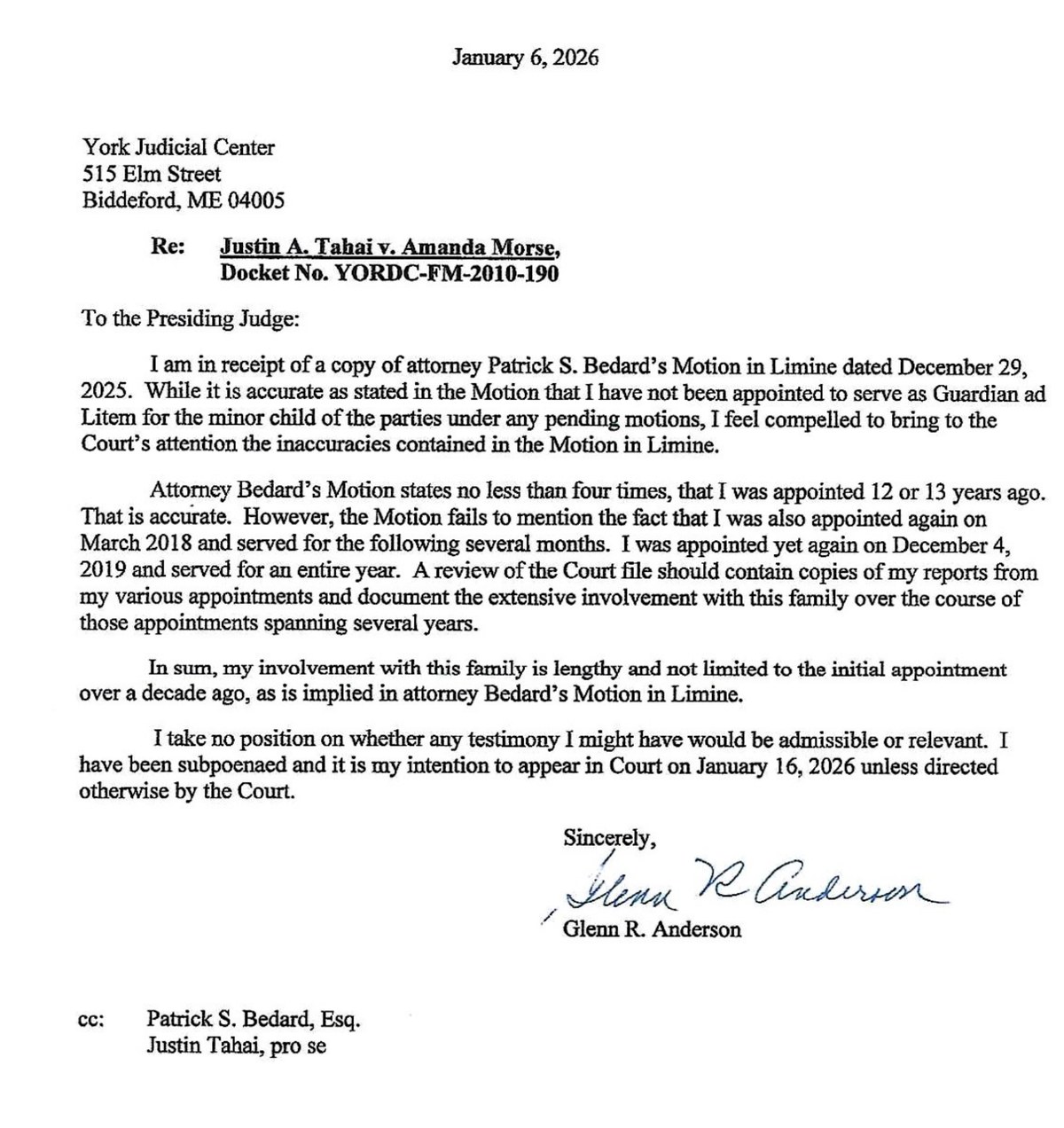
The page now leads with Glenn R. Anderson’s January 6, 2026 letter to the presiding judge identifying “inaccuracies” and omitted later appointments in Bedard’s Motion in Limine. Court filings, party-attested exhibits, legal standards, child-impact research, and first-person commentary remain labeled separately, with a published right-of-reply and correction process.

Primary source · January 6, 2026Glenn R. Anderson told the presiding judge that Patrick S. Bedard’s Motion in Limine contained “inaccuracies.”Read the letter and candor analysis

What this page contains: a source-linked timeline, downloadable filings and exhibits, Maine legal and professional standards, child-impact research, first-person commentary, and a documented correction path.

Related reference: Justin Tahai’s Google review of Patrick S. Bedard is independently hosted and clearly identified as opinion.

Public-record accountabilityOpinion labeledSource-navigation exhibitsNo private-location dataCorrection path included
January 6, 2026 · Direct court letter · Attorney-candor record

A former court-appointed GAL told the court that Patrick S. Bedard’s motion contained “inaccuracies.”

Glenn R. Anderson, Esq. wrote directly to the presiding judge about Bedard’s December 29, 2025 Motion in Limine. Anderson identified omitted later appointments and rejected the motion’s implication that his involvement with the family was limited to an appointment more than a decade earlier.

Direct sourceAddressed to presiding judgeBedard copiedDated January 6, 2026Rule 3.3 relevance

The letter’s central statement

“I feel compelled to bring to the Court’s attention the inaccuracies contained in the Motion in Limine.”
  • Anderson wrote that Bedard’s motion said at least four times that Anderson had been appointed 12 or 13 years earlier.
  • Anderson said the motion failed to mention that he was appointed again in March 2018 and again on December 4, 2019, with service spanning additional months and a full year.
  • Anderson concluded that his involvement was lengthy and was not limited to the initial appointment, contrary to the implication he identified in Bedard’s motion.
Why this belongs in the attorney-candor lane

Maine Rule of Professional Conduct 3.3(a)(1) addresses knowingly false factual statements to a tribunal and failure to correct a prior material false statement. Anderson’s letter is not itself a judicial or disciplinary finding that Bedard violated Rule 3.3. It is direct record material that squarely raises whether the court was given an accurate account and whether any correction was required.

Cropped preview of Glenn R. Anderson's January 6, 2026 letter to the presiding judge concerning inaccuracies in Patrick S. Bedard's Motion in Limine
Primary-source exhibitJanuary 6, 2026 letter from Glenn R. Anderson, Esq. to the presiding judge in YORDC-FM-2010-00190; Patrick S. Bedard and Justin Tahai are shown as copied recipients.
Publication boundary: the controlling exhibit is Anderson’s letter itself. This page accurately labels the document as a direct source and separates what Anderson wrote from any later court or disciplinary determination.

Public record library

The accountability pages now route readers through a filterable source center. Each source is labeled by type, lane, quality, and what it supports, so verification does not depend on accepting narrative characterization.

Open public record library · Evidence matrix · Citation bank

Visitor-first brief

The Bedard page in 60 seconds.

This page is intentionally sharp, but it is organized so a visitor can separate public record, party attestation, source-navigation exhibits, opinion, and correction requests without having to read every PDF first.

Public record · Updated July 23, 2026
Summary

What it says

It names Patrick S. Bedard as a professional actor in a public-facing family-law record involving prolonged conflict, post-order implementation issues, Board lanes, and public-official review.

Sources

What it uses

It leads with Glenn Anderson’s January 6, 2026 letter identifying “inaccuracies” and omitted later GAL appointments in Bedard’s Motion in Limine, then surfaces the corrected 26-240 conduct extract, July 8 filing, and public-safe PDFs.

Opinion

What is opinion

Characterizations about litigation incentives, professional responsibility, and public accountability are opinion unless tied to a specific record event or source.

Verify

How to verify

Start with the conduct timeline and PDFs, then use the source list and correction path for any disputed date, quote, characterization, or omission.

Attorney accountabilityJanuary 6 Anderson letter includedCorrected 26-240 extract includedJuly 8 letter includedRight-of-reply pathResearch-backed child-impact lens

Visitor standard: read the strongest claim on the page next to its record posture. If a sentence is opinion, treat it as opinion. If a sentence is a dated record anchor, check the linked PDF, docket, native message, or official source.

Formal proof route

The Bedard lane now routes through the master evidence matrix.

The attorney-accountability page should be read beside the evidence matrix: claim, record anchor, professional rule, child-impact research, public question, and correction path. That structure keeps the page formal, fast to verify, and harder to dismiss as unsupported rhetoric.

1. Read the dated conduct anchor.2. Match the claim to a professional rule.3. Use child-impact research only for risk and urgency.4. Request correction by exact sentence and source.
Claim-by-claim support map

The accountability argument does not depend on volume or outrage. It stands on record, rules, research, and correction procedure.

The public question is not whether every reader agrees with every characterization. The question is whether the dated record, attorney-duty rules, child-impact research, and open correction path leave the need for accountability reasonably dismissible.

Record

Dated source-navigation

Conduct extracts, July 8 filing, PDF packets, Board lanes, and party-attested anchors identify what should be checked.

Rules

Professional standards

Candor, no improper delay/burden, misconduct, attorney oath, and statutory contact/records provisions define the accountability standard.

Research

Child-impact science

Conflict exposure, alienating behaviors, toxic stress, and disrupted parent-child relationships are not harmless procedural background.

Correction

Right-of-reply pathway

The page invites specific record corrections. A disputed page is stronger when the correction path is open and precise.

Attorney-accountability claim map.

Each lane is written so a visitor can verify the public claim without accepting a conclusion on trust.

Claim

Record integrity matters. A family-court record cannot become a curated litigation narrative while the child lives the consequences.

Record anchor

July 8 filing, corrected conduct timeline, Board lanes GCF-25-524 and 26-240.

Legal support

M.R. Prof. Conduct 3.3; M.R. Prof. Conduct 8.4(c)-(d); 4 M.R.S. § 806.

Clinical / public concern

Child-impact litigation should be tested against lived harm, not just procedural endurance.

Claim

Orders on paper are not implementation. Contact, therapy, and records access must become real in the child’s life.

Record anchor

Post-February 11 implementation requests; school, medical, dental, therapy, insurance, and MaineCare/DHHS lanes.

Legal support

19-A M.R.S. § 1653(1)(C), (2)(D)(4), (3)(H)-(J), (7).

Clinical / public concern

O’Hara et al. (2019, 2023); Rhoades (2008); Harold & Sellers (2018).

Claim

Delay can be a tactic and a harm amplifier. Litigation conduct that burdens, delays, or prejudices justice deserves public scrutiny.

Record anchor

Implementation nonresponse, repeated notice, Board addenda, July 8 public-official review request.

Legal support

M.R. Prof. Conduct 1.3, 4.4(a), 8.4(d); 4 M.R.S. § 806.

Clinical / public concern

CDC ACEs; Shonkoff et al. (2012); Strathearn et al. (2020).

Claim

Alienating behaviors and adult-conflict exposure are not side issues. They are child-impact issues.

Record anchor

Glenn Anderson witness lane, adult-conflict exposure concerns, therapy/contact logistics, child-gatekeeper framing.

Legal support

19-A M.R.S. § 1653(3)(H)-(J), (N).

Clinical / public concern

Verhaar et al. (2022); Rhoades (2008); Harold & Sellers (2018); Sarkadi et al. (2008).

Visitor verification standard

Before sharing the Bedard page, keep the record disciplined.

This page is strongest when readers can tell what is a filed document, what is a party-attested timeline anchor, what is opinion, and where a correction can be made.

1

Open the source first

Use the PDF/source cards before repeating a conclusion. The page is designed for verification, not rumor.

2

Keep private data out

Do not republish child-identifying, private-location, private-phone, sealed, or confidential material.

3

Label opinion as opinion

Sharp commentary is protected by clarity: identify what is opinion, what is a filing, and what is party-attested.

4

Use the correction path

A specific record correction belongs in the right-of-reply/correction lane, not in vague denial or silence.

Research-backed accountability lanes

Make the accountability lanes checkable from four directions.

The strongest version of this page does not ask visitors to accept outrage. It lets them verify the same concern through record anchors, Maine law/rules, official court data, and child-impact research.

Official law/rulesNLM / CDC researchJudicial Branch dataParty-filed record
Official Maine rules

Candor and timely progress are professional-responsibility lanes.

Maine Rule 3.3 requires candor toward the tribunal. The Maine professional-conduct rules also recognize the lawyer’s obligation to move litigation toward conclusion in a timely manner. That makes record integrity and delay-incentive criticism a professional-accountability issue, not a personality dispute.

Maine best-interest law

Parent-child contact and cooperation are statutory factors.

Maine’s parental-rights statute includes each parent’s capacity to allow and encourage frequent, continuing contact and each parent’s capacity to cooperate or learn to cooperate in child care. That supports treating contact interference, records access, and implementation friction as core child-impact issues.

Peer-reviewed child-impact research

Conflict exposure and alienating behaviors are not neutral background noise.

NLM-indexed research links interparental conflict with child adjustment concerns. A systematic review of parental alienating behaviors reports long-term emotional consequences while acknowledging that careful, evidence-bound use is necessary in contested family matters.

Official public-health / family research

Child stability and safe bonding are public-health concerns.

CDC ACEs material recognizes that a child’s environment can undermine safety, stability, and bonding. NLM-indexed father-engagement research also supports the broader protective value of meaningful father involvement. That is why implementation delay matters in real time.

Research guardrail: these sources do not prove every case-specific allegation. They strengthen why the allegations matter. In child-impact litigation, delay, conflict exposure, contact obstruction, record distortion, and non-implementation are foreseeable risk lanes — not harmless paperwork.
Recorddated extracts, July 8 filing, PDF source rail
Rulescandor, timely progress, best-interest factors
Researchchild conflict exposure, bonding, father involvement
Datastatewide appellate pressure and family-court trends
record-supported accountability lanes

Make the attorney-accountability lane easier to verify.

This page now ties the conduct record to a public statement, Maine professional rules, child-impact research, official court data, and source PDFs. The reader does not have to accept rhetoric; the reader can inspect the lane.

Party-filed / source-navigation

Record

The conduct timeline, 26-240 addendum, July 8 filing, and PDF rail show the public-record lane that supports why Bedard is named.

Professional responsibility

Rules

Maine Rule 3.3 candor, fairness, and lawyer-as-officer-of-the-court principles make record integrity and delay incentives professional accountability issues.

Child-impact harm

Research

NLM/PMC and CDC sources support the public-policy point that conflict exposure, disrupted bonding, and delayed repair are not harmless background conditions.

Systemic incentive argument

Public statement

The new long-form statement frames prolonged family litigation as a system problem: diffused accountability, delay, hourly-fee incentives, and children carrying the cost.

Use standard: this page separates allegations, filed material, public data, rules, research, and opinion. That makes correction easier, source review clearer, and public review cleaner.
The standard

This page is about accountability, not rumor.

PUBLIC BOUNDARYNo private-location, child-identifying, sealed, or confidential material is intentionally published here.
Public-use boundary: This page does not publish personal-location data, family-member data, private phone/address information, sealed records, child names, or confidential materials. It uses public professional identity, public-policy framing, source-backed research, and record-checkable claims. This site does not republish people-search or personal-location listings, even where those listings may appear elsewhere online.

Patrick S. Bedard is named here because he is a professional actor in a public-facing legal system and, in my view, his role in prolonged family litigation belongs in the public accountability record. Where a statement is my opinion, it should be read as opinion. Where a statement concerns a record event, it should be checked against the docket, filings, orders, communications, and public materials.

The public should not have to accept vague complaints. The public should be able to inspect dates, incentives, conduct, and consequences.

Why Patrick S. Bedard is named

General criticism is easy to dismiss. A named public record is harder to ignore.

His own professional profile identifies him as an attorney in Maine and New Hampshire since 1988 and lists divorce among his practice areas. That professional public role matters because family-law practice does not happen in a vacuum. The conduct of attorneys, not only judges or agencies, shapes whether a family matter moves toward resolution or remains trapped in conflict.

Professional role

This is about a lawyer acting in a family-law context, not a private person dragged into a private fight.

Record visibility

The page is built around checkable claims, source links, and a correction/right-of-reply standard.

Public concern

When litigation harms parent-child relationships for years, the public has a legitimate interest in how that happened.

Predatory family-law incentives

What I mean by “predatory” is a litigation pattern that profits from prolonging family conflict.

In my opinion, a family-law practice becomes predatory when the process rewards delay, escalation, procedural churn, and exhaustion while the child’s relationship with a parent deteriorates in real time.

The concern is not that lawyers should stop advocating. The concern is that advocacy in family matters can become destructive when tactical advantage matters more than timely child-centered resolution.

  1. Conflict becomes billable inventory. When every dispute, delay, letter, motion, or continuance creates more legal work, prolonged conflict can become financially useful to the professionals around the case.
  2. Delay becomes leverage. A parent-child relationship can be eroded not only by one dramatic order, but by months and years of inaction, uncertainty, and unanswered disruption.
  3. Children experience procedure as loss. A child does not experience litigation as legal strategy. A child experiences missed contact, divided loyalty, instability, and adults unable or unwilling to resolve the conflict.
  4. The public loses trust. When families see litigation expand while basic relationship protection fails, public confidence in courts, lawyers, and institutions erodes.
  5. Corrected Bedard Conduct-Related Timeline Extract with 26-240 Addendum - July 7, 2026. Corrected source-navigation PDF adding newer Board matter 26-240 to the GCF-25-524 professional-conduct oversight history; not Board findings or judicial findings.
Generational harm

Children do not get their childhood back when the docket finally slows down.

Family litigation is different from ordinary civil litigation because a child is developing while adults fight. Every month can change attachment, school stability, identity, trust, and a child’s understanding of family. A child can grow up inside the case.

Research on adverse childhood experiences and interparental conflict supports a basic public-policy truth: prolonged instability, unresolved conflict, and separation-related stress can carry long-term risks for children. Most children are resilient, but resilience is not an excuse to let systems or professionals normalize avoidable harm.

Loss becomes routine

Missed calls, missed birthdays, missed school moments, and lost ordinary time can become the child’s normal.

Conflict becomes developmental

A legal fight can become part of the child’s emotional environment, not merely the parents’ dispute.

Harm echoes forward

The child, the parent-child relationship, future relationships, and public trust can all carry the consequences.

Record frame

The page should force the right questions.

The question is not whether Patrick S. Bedard dislikes this page. The question is whether the record can be checked and whether Maine’s family-law system is willing to examine how attorney conduct and incentive structures contribute to prolonged harm.

Use this page to ask: What positions were taken? What delays occurred? What orders were not implemented? What contact was lost? What did the child experience while adults litigated? Who benefited from the case continuing? Who paid the cost?

Those are public-accountability questions. They belong on a campaign and public-record site because Maine families need systems that prioritize timely resolution, child stability, compliance, transparency, and measurable correction.

Conduct-related timeline anchors

The corrected July 7, 2026 conduct extract adds Board matter 26-240 to the dated record-navigation map.

SOURCE-NAVIGATIONSummaries point to PDFs, emails, docket materials, and party-attested timeline anchors; controlling records remain native sources.
Party attestation and limitation: Justin Tahai attests that these selected anchors are true to the best of his knowledge and records as a party to the matter. The linked corrected extract is source-navigation and public-accountability notice material and now carries both GCF-25-524 and 26-240 Board lanes. It is not presented as judicial findings, and native emails, official docket sheets, certified records, Board files, and court records remain controlling.

The attached extract is filtered from the master timeline for entries involving Patrick S. Bedard / Bedard-Bobrow and the professional-responsibility, notice, implementation, records-access, school/therapy, transcript/audio, court-access, and federal-preservation lanes. It identifies 78 selected entries plus a corrected front addendum carrying five 26-240 Board-lane anchors and expressly says obvious duplicates were omitted while routine service-only items were generally excluded unless they established notice, preservation, or process-integrity issues.

83selected conduct-related anchors, including 26-240 addendum entries
7docket / oversight lanes named, including 26-240
2,349Bedard / Bobrow index hits reported in public release
108k+legal-matter print-equivalent pages routed into targeted review
Why this matters: the extract does not ask readers to accept a vague accusation. It shows notice, service, implementation requests, nonresponse allegations, transcript/audio barriers, school, therapy, medical/dental access concerns, Law Court preservation, Board grievance materials, the newer 26-240 grievance lane, and the practical problem of reviewing a massive legal record without dumping every page onto the public website.
2016 contempt context

Gatekeeping dynamics were documented as early as the 2016 contempt period.

The extract preserves a March 2016 observation involving parent-child contact dynamics and inconsistent access standards, treated as a legacy timeline anchor rather than a judicial finding.

Parent-child contact · Professional conduct
Sept.–Dec. 2025

Pre-hearing written notice and resolution attempts were active before the January hearing.

Selected entries include subpoena/enforcement exchanges, attendance concerns, witness/evidence lanes, and a December 7, 2025 written attempt to propose an amicable resolution path before the final-hearing cycle.

Notice · School attendance · Evidence preservation
Jan. 20, 2026

Post-hearing fairness and proposed-order concerns were preserved immediately.

The extract identifies a motion to disqualify Patrick Bedard, objection to proposed orders, and proposed child-support order issues as a post-hearing record-distortion / fairness lane.

Professional conduct · Proposed orders · Fairness lane
Feb. 14–16, 2026

Immediate post-order implementation requests were documented.

Entries state that a February 14 electronic-contact logistics request was sent after the February 11 order, followed by a February 16 comprehensive compliance email requesting therapy, electronic contact, in-person contact, healthcare, education, insurance, records access, support, and documentation confirmation.

Implementation · Electronic contact · Records access
Feb. 20, 2026

The Board lane was tied to alleged post-order implementation obstruction.

A supplemental Board grievance update in GCF-25-524 alleged that written requests for electronic contact, therapy scheduling, transport, and records/authorization access had not been meaningfully addressed.

GCF-25-524 · Professional conduct · Implementation obstruction alleged
Feb.–Apr. 2026

Transcript/audio and record-access barriers became part of the accountability record.

The extract includes a February 18 motion for electronic recording in lieu of transcript, March transcript-status notice, and April 29 no-transcript notice / record-preservation communications copied to counsel.

Transcript/audio · Law Court · Record access
Apr. 21–25, 2026

Implementation posture was disputed in writing, including child-gatekeeper framing.

Entries preserve counsel-level implementation posture, a disputed “sole gatekeeper” interpretation of contact, and requests for counseling/contact time to be protected and made up.

Parent-child contact · Counseling logistics · Order implementation
Apr.–May 2026

School attendance and parent-access concerns remained current and documented.

The extract identifies attendance messages, portal screenshots, annual-update/school-access concerns, and May 12 attendance totals/repeated tardies sent to Morse/Bedard as current quantitative anchors.

School attendance · Parent access · Counsel notice
May 14, 2026

Law Court and trial-court implementation burdens were preserved across lanes.

The extract states that the Law Court / trial court implementation demand email copied Patrick Bedard and identified overlapping Law Court, trial-court, federal, school/provider, eFiling, record-preservation, and counseling/contact burdens.

Law Court · eFileMaine · Federal preservation
June 8, 2026

The 108,000+ page problem was converted into targeted review paths.

The supplemental notice asked the court to treat reports as indexes and preservation tools, not as a request to print or submit every underlying record at once, and requested targeted subsets for review.

Case management · GAL review · Targeted packets
June 23–25, 2026

Late-June anchors preserve individual therapy, adult-conflict exposure, and service metadata.

V17 entries preserve emails about individual therapy availability, the child carrying adult conflict, Rule 5/status-presentment materials, Tyler/eFileMaine service notices, and federal appeal-record activity forwarded to counsel.

Individual therapy · Tyler service · Federal appeal record
July 5, 2026 · 26-240

Corrected addendum carries forward the newer Board matter number 26-240.

The corrected addendum states that the prior extract identified GCF-25-524 but did not separately carry forward newer Board matter 26-240. The page now treats 26-240 as a separate public-accountability and professional-conduct review lane, while keeping the limitation that this is notice and source-navigation material, not a Board finding.

26-240 · GCF-25-524 history · Professional-conduct review lane

Open the Maine Board of Overseers public accountability record

July 5, 2026 · Public notice

26-240 public-notice email tied the newer grievance matter to continuing child-impact harm.

The addendum identifies a July 5, 2026 email to the Maine Board of Overseers of the Bar, BCService, Judicial Branch courtesy recipients, Law Court clerk, Mr. Bedard, Ms. Morse, and public-accountability recipients. The subject preserved continuing child-impact harm and requested immediate professional-conduct review.

Board notice · Continuing child-impact harm · Professional-conduct review request
July 5, 2026 · Review request

26-240 was expressly requested to be reviewed with the GCF-25-524 history in view.

The addendum says the 26-240 request asked the Board to consider the earlier GCF-25-524 history, long-running parent-child deprivation, compliance/logistics treated as negotiable, status-quo hardening through delay, school-stability consequences, records-access consequences, transcript/audio barriers, and accumulated evidence of friction/filtering/strategic posture instead of straightforward adult compliance.

GCF-25-524 context · Delay pattern · Records access · Transcript/audio barriers
July 5, 2026 · Witness lane

Glenn Anderson witness request was renewed under the 26-240 lane.

The corrected addendum renews the request that Glenn Anderson, Esq., who served as Guardian ad Litem on three occasions, be considered as a witness with long-range perspective on recurring patterns, child impact, and how litigation conduct translated into real-world harm over time.

GAL witness request · Long-range pattern evidence · Child impact

This section intentionally avoids reproducing private email addresses, child-identifying details, or private-location data in the page body.
July 8, 2026 court filing / public-official review

The July 8 filing belongs on the Bedard accountability record because it names the professional-responsibility, candor, and counsel-incentive lanes directly.

FILED / PUBLIC-OFFICIAL REVIEW LANEThis section summarizes the July 8 filing as public-record accountability material, not a judicial or disciplinary finding.
Party-filed public-record anchor: Justin Tahai identifies the July 8, 2026 letter and cover letter as a filed court communication and public-official review request in YORDC-FM-2010-00190. This page summarizes the filing as a public-record accountability exhibit, not as a judicial finding or disciplinary finding. The PDF itself remains the controlling web exhibit.

The filing asks the court and copied public officials to stop treating delayed implementation, adult-conflict exposure, records and school-access issues, therapy/contact failures, counsel-driven gamesmanship, and judicial inaction or avoidance as fragmented procedural compartments. It identifies the role of counsel Patrick S. Bedard, requests public-official review of predatory family-law incentives, and asks officials to examine the filings, hearing audio, prior GAL materials, the January 6 former-GAL letter, the February 11 order and failed implementation, school/records issues, and the repeated pattern by which a child-impact case was permitted to become a professional revenue stream and procedural endurance contest.

Public-use boundary: this section does not ask anyone to contact, pressure, threaten, or privately confront any participant. It exists because the July 8 filing is part of the public-record accountability lane and because the filing directly connects attorney conduct, Rule 3.3 candor concerns, public-official review, and child-impact implementation harm.
July 8, 2026 · Court letter

Bedard is named in the public-official review request.

The filing states that the attached letter identifies specific litigation conduct and incentives reflected in the record, including the role of counsel Patrick S. Bedard, and asks public officials to examine the underlying filings, audio, GAL materials, implementation record, school/records issues, and pattern evidence rather than merely accepting one party's characterization.

Counsel role · Public-official review · Record inspection
Rule 3.3 / candor lane

The filing says the record cannot be allowed to become a curated litigation narrative.

The letter ties Candor Toward the Tribunal to the family-court record itself: where a child absorbs consequences outside the courtroom, source-backed record integrity matters and disputed narratives should be tested against documents, audio, GAL history, and implementation evidence.

Rule 3.3 · Record integrity · Candor toward tribunal
Professional incentives

The filing frames predatory family-law practice as a public-system issue.

The filing asks for review of whether family litigation can become a fee-generating pressure system in which lawyers profit from delay, narrative exhaustion, obstruction of contact, records-access disputes, and procedural churn while children and parents absorb the harm in real life.

Professional responsibility · Delay incentives · Public trust
Neutral witness / GAL lane

The filing ties Bedard, Glenn Anderson, and record correction together.

The letter asks that former GAL Glenn Anderson's January 6 letter and relevant testimony be considered if necessary, because a neutral attorney and former court-appointed professional with repeated GAL history could address the longer pattern, alleged disparagement, narrative management, and the prior judicial effort to curb repeated filings without evidentiary basis.

Former GAL · Neutral witness · Record correction
Download exhibit

Open the July 8 letter and cover letter PDF.

This PDF is now linked from both the court-accountability page and the attorney-accountability page because it crosses both lanes: judicial delay and counsel-driven professional-responsibility concerns.

Open July 8 court letter / public-official review PDF

Court filing · Public-official review · Bedard accountability record
Record PDFs

The PDF record belongs directly on this page.

DOWNLOADABLE SOURCE KITPDFs are grouped so visitors can inspect the underlying record without hunting through the site.
108,000 pages is not justice. The point of the PDF rail is to make the public record easier to inspect without forcing readers to hunt through the site. This section links the by-the-numbers PDF, the public-safe petition PDFs, the record index, and public email-render PDFs related to the campaign/accountability record.

These are public-use PDFs. This page still does not republish sealed records, child names, confidential materials, private phone/address information, family-member data, or people-search/personal-location listings.

July 8 court letter

Letter to Court and Public-Official Review Request - July 8, 2026

Filed court letter and cover letter naming the Bedard professional-responsibility, candor, public-official review, and counsel-incentive lanes. Linked here because the filing belongs on the attorney-accountability page as well as the court-accountability page.

Open PDF
Corrected conduct timeline

Corrected source-navigation PDF placing Board matter 26-240 at the front of the extract while preserving the original timeline pages behind it. It ties 26-240 to the prior GCF-25-524 professional-conduct lane and the continuing child-impact / implementation-drift record. Not presented as Board findings or judicial findings.

Open PDF
Conduct timeline

Source-navigation PDF with 78 selected anchors involving Bedard / Bedard-Bobrow, GCF-25-524, 26-240, post-order implementation, record access, school/therapy, court access, and process-integrity lanes. Party-attested by Justin Tahai; not presented as judicial findings.

Open PDF
Core record frame

108,000 Pages Is Not Justice - By the Numbers

Public-facing by-the-numbers PDF explaining the 108,000-pages frame and why record volume without timely relief is not justice.

Open PDF
Petition PDF

Public Citizen Petition - June 27, 2026

Standalone public citizen petition packet for officials, press, and public review.

Open PDF
Follow-up petition

After Notice Public-Safe Petition - July 6, 2026

Public-safe after-notice petition packet focused on continued institutional notice and child-centered urgency.

Open PDF
Record index

After Notice Record Attachment Index - July 6, 2026

Index PDF for organizing the public-safe record attachments without republishing private or sealed materials on the web page.

Open PDF
Follow-up petition

Follow-Up Petition: Stop Harming Our Children - July 6, 2026

Follow-up public petition centered on children, delay, institutional notice, and ongoing harm.

Open PDF
Email record

Email Blast: Public Citizen Petition - June 27, 2026

PDF render of the public email blast transmitting the citizen petition.

Open PDF
Email record

Email Blast: After Notice Continued Silence - July 6, 2026

PDF render of the after-notice email communication regarding continued silence and public accountability.

Open PDF
Email record

Email Blast: Follow-Up Stop Harming Our Children - July 6, 2026

PDF render of the follow-up communication focused on stopping child harm.

Open PDF
Email record

Email Blast: Tyler/eFileMaine Access Barriers - July 6, 2026

PDF render documenting the access-barrier communication related to Tyler/eFileMaine.

Open PDF

Open the full PDF chooser for broader family tools, guides, and printable packets.

Right of reply and correction

If any record fact is wrong, identify it specifically.

Patrick S. Bedard may disagree with my characterization of his role. He is free to respond publicly, identify specific record points he believes are inaccurate, and provide his own explanation of the litigation positions and strategy used in this matter.

If he believes this page misstates a record fact, he may identify the specific statement, the record source, and the correction he believes is required. Disagreement will not be treated as censorship. Unsupported demands for silence will not erase the public concern.

The standard is simple: dates, documents, docket history, communications, orders, conduct, consequences, and child-centered accountability.

Record reading standards

How this attorney-accountability page is meant to be read.

The page is intentionally sharp, but the visitor experience is built around verification. Each lane should be read by source type: filed material, source-navigation exhibits, official/public records, party attestation, and opinion.

Filed / public-record material

Court letters, packet PDFs, public notices, and record indexes are surfaced as downloadable exhibits, not hidden behind commentary.

Source-navigation exhibits

Timeline extracts organize anchors and notice lanes. They are not presented as court, Board, or disciplinary findings.

Party-attested claims

Where Justin attests to a record event, the page says so and leaves native emails, dockets, Board files, and certified records controlling.

Opinion and accountability

Characterizations are framed as opinion/public accountability, with a correction lane for specific factual disputes.

1
Boundary

No child names, sealed records, private-location data, or confidential material.

2
Record anchor

Dated filings, PDFs, public data, or source-navigation exhibits come first.

3
Attestation

Party-attested material is labeled and native records remain controlling.

4
Opinion

Sharp public-accountability conclusions are identified as opinion.

5
Correction

Specific factual corrections are invited and should cite the exact item disputed.

In-text citation bank

Attorney accountability needs more than outrage. It needs citations.

These are copy-ready legal and clinical citations for the accountability lanes. They do not replace the native record, but they make the standard of review harder to dismiss.

Candor to tribunal

M.R. Prof. Conduct 3.3

A lawyer may not knowingly make false statements of fact or law, fail to correct material false statements, or offer false evidence.

Use as: M.R. Prof. Conduct 3.3. Source: Maine Rule of Professional Conduct 3.3.
Delay no person for lucre or malice

4 M.R.S. § 806

Maine’s attorney oath forbids falsehood, groundless suits, and delaying another for lucre or malice.

Use as: 4 M.R.S. § 806. Source: Maine Attorney's Oath.
No delay/burden tactics against third persons

M.R. Prof. Conduct 4.4(a)

A lawyer may not use means with no substantial purpose other than to embarrass, delay, or burden a third person.

Use as: M.R. Prof. Conduct 4.4(a). Source: Maine Rule of Professional Conduct 4.4.
Misconduct / administration of justice

M.R. Prof. Conduct 8.4(c)-(d)

Professional misconduct includes dishonesty, fraud, deceit, misrepresentation, and conduct prejudicial to the administration of justice.

Use as: M.R. Prof. Conduct 8.4(c)-(d). Source: Maine Rule of Professional Conduct 8.4.
Interparental conflict

Rhoades (2008)

A meta-analysis found associations between children’s responses to interparental conflict and internalizing, externalizing, relational, self-esteem, and physiological outcomes.

Use as: Rhoades (2008). Source: Children’s responses to interparental conflict.
Parental alienating behaviors

Verhaar et al. (2022)

A systematic review reports that exposure to parental alienating behaviors in childhood can have profound later-life mental-health impacts.

Use as: Verhaar et al. (2022). Source: Impact of parental alienating behaviours.
Boundary: citations support why the conduct and delay lanes matter. They do not convert allegations into findings, diagnoses, or legal advice.
First-person public commentary

Google review by Justin Tahai

This external review is Justin Tahai’s first-person account and opinion. It is presented separately from court records, official sources, and adjudicated findings.

Read Justin Tahai’s Google review of Patrick S. Bedard

Sources and record basis

Start with sources that can be checked.

New systemic statement: The long-form Maine Judicial Branch accountability statement is now part of the public accountability lane and should be read with this page as a statewide public-policy frame, not a private request for off-record action. Read the statement · Download DOCX
Commentary lane: Public-policy criticism, satire, and first-person analysis are collected separately from the Bedard record so readers can distinguish argument from court records and official sources. Open Articles & Public Commentary.
VERIFY HEREUse this section to check the foundation before relying on or repeating any claim.
Public accountability lane

The remedy is not silence. The remedy is a record that can survive hostile review.

This page is one part of the broader JTforME public-record lane. The campaign’s position is that Maine family-court reform must protect safety, preserve due process, avoid private-case intake, and still be honest about professional incentives that allow children and parents to lose years inside litigation.

Publication standard

Public accountability has to be readable, checkable, and bounded.

Record firstClaims are tied to filings, public-safe PDFs, source-navigation extracts, docket lanes, or party-attested records.
Opinion labeledWhere the page uses judgment language, it identifies the statement as opinion or public-accountability position.
Private data excludedThe page does not publish personal-location listings, private phone/address data, child names, sealed records, or confidential materials.
Correction path openAnyone asking for correction should identify the exact sentence, the source they rely on, and the corrected wording requested.
Chronology with receipts

See the accountability record in sequence.

The public release timeline separates documented events, disputed assertions, implementation benchmarks, child-impact signals, and public-review requests. Chronology is presented as an audit aid—not as stand-alone proof of motive or causation.

Open accountability timeline Open machine-readable data

Accuracy + fairness

Corrections and right of reply

Material factual corrections, source-supported clarifications, and concise responses from people or institutions directly discussed are handled under a published review policy.

Read the correction policy