About + governing posture
This page is for understanding the service frame, systems thinking, and family reason underneath the public-facing work.
No private case intake: do not send child names, sealed records, private allegations, or confidential files through public campaign links. Privacy boundarySafety first
Site boundary: JTforME is the campaign, public-record, citizen-initiative, and Maine family-help routing hub. For volunteer-only public education, printable tools, and research/source materials, use FOCaF.
I want people in Maine to know exactly how I approach this: tell the truth about what the system is producing, measure it, and fix what keeps causing preventable harm.
Use it when the question is who I am, why I am doing this, and what service standard I am trying to hold—not just the policy record by itself.
This page is for understanding the service frame, systems thinking, and family reason underneath the public-facing work.
Use it when the reader needs the human origin and service posture, but still in a disciplined way.
For many readers, the public record should still come first.
This page should hand readers into the dashboard, platform, standards, or open letter once the stance is clear.
This belongs near the front because it is a governing premise for the whole site, not a footer afterthought.
This effort is grounded in public literacy — not ideology. Citizens deserve to understand how administrative systems work, where inefficiencies arise, how accountability can be structured lawfully, and what reform mechanisms are realistic. Informed participation strengthens democracy.
Show how the machinery works, where drift and inefficiency arise, and what lawful reform doors actually exist.
The point is not to recruit ideological agreement. The point is to help people see the structure clearly enough to judge it for themselves.
Read the dashboard, proof layer, and standards pages to see whether the site is actually doing what this promise says.
This only matters if the literacy work helps families, skeptical readers, officials, and the public understand what must change.
The About page should explain the family reason, the civic-literacy standard, the engineering posture, and the service motive—then hand readers back into the public record instead of asking biography to do all the work.
That is the shortest honest answer to why this work exists at all.
This is where the page explains that the work is grounded in public understanding, not ideology or prestige.
The page should connect the personal reason to a disciplined public-service method, not just biography.
Readers should be able to verify whether the public work actually matches the stated standard.
The About page should not dead-end in biography. It should return readers to the platform, packets, or open letter as needed.
These nearby pages keep biography, standard, proof, and public use from drifting too far apart.
Use the personal origin page when readers need the sharper starting voice.
Open Open letterRead the flagship public-record page when you need the campaign case in one place.
Open State of Maine FamiliesUse the standard-setting page when the question is what a fix should be judged against.
Open StandardsUse the intake page to place lived experience beside the larger public record.
Open Story intakeIf child-access pressure, family-court pressure, or fear for safety is making today feel dangerous or unbearable, start with crisis support, counseling, and the cleanest Maine justice doors first.
I come at public problems the same way I approach technical systems: make the failure visible, reduce drift, and measure improvement.
I am not trying to turn office into personal status. I want the public-facing work to stay grounded in usefulness and accountability.
The site keeps returning to children and families because delay is lived in real time there, not in theory.
Policy, proof, and practical tools are separate lanes here, but they are meant to reinforce the same public-interest standard.
This page should explain posture, not trap people in a personal narrative. If someone needs the public record, the practical doors, or the execution standard, route them there cleanly.
I am doing this because childhood keeps moving while institutions deliberate. If a public system keeps producing preventable harm for families, I do not think the honest response is to shrug at it, brand around it, or wait for someone else to take it seriously.
My name is Justin Tahai. I am an IT engineer. I believe systems can be fixed, but only after people are willing to state plainly what the system is actually producing for real families in Maine.
I want the public-facing work to stay disciplined: name the failure, measure the pressure, reduce drift, and judge reform by whether it changes outcomes people can actually feel.
I am not seeking authority over anyone for its own sake. I am not running for salary. I am not interested in bureaucratic prestige. I am running because children and families in Maine deserve a government that treats preventable harm like something worth fixing.
If you want the quickest picture of how I think, start with the initiative, the dashboard, and the source library.

Alongside policy work, I am building technology intended to reduce procedural complexity and help families navigate legal process with greater clarity.
Separate lane. Same standard.
An engineer’s approach to public service starts with the public record: counts, timelines, staffing need, and where pressure is actually showing up in the system.
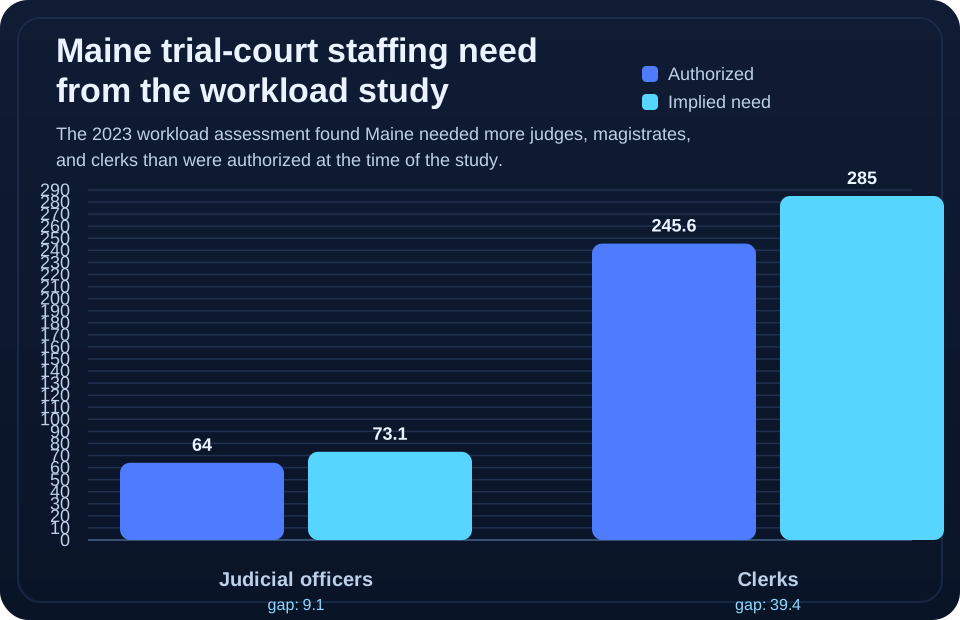
When public institutions can show their own backlog, their own staffing gap, and their own caseload concentrations, reform stops being a vague complaint and becomes a governed problem with measurable failure points.
That is the posture I am bringing to this campaign.
Public institutions shape daily life — courts, administrative agencies, regulatory bodies, licensing systems, and the services people rely on during life’s most consequential moments. When these systems function well, citizens rarely notice them. When they fail, the consequences are immediate.
In the private sector, failure creates pressure: lost customers, lost revenue, competitive displacement. That pressure drives iteration. Performance is tracked. Timelines are transparent. Feedback loops are built into operations. Public institutions often lack comparable performance feedback loops — and delay becomes normalized instead of corrected.
These systems aren’t perfect — but they evolve because performance is measurable. Public systems can adopt the same discipline without turning government into a business or compromising due process.
That standard now appears near the front of this page where readers can see it before the systems discussion gets long.
The problem has never been “too much liberty.” The problem has always been too much bureaucracy without accountability. Government does not need more authority — it needs better execution: structured reform, measurable standards, transparent timelines, and leadership measured by outcomes — not just compliance.
This is included here as outside publication, not campaign copy. The publisher controls access and presentation.
I want people to understand how I think, what standard I am trying to hold, and where to go next if they want the public record instead of the personal framing.
A shorter route through the governing posture, measured-proof standard, and where this page should hand off to the public-work pages.
The strongest first link for most readers is still the flagship page, because it carries the public record and the measurable response in one place.
The platform page explains how the lanes fit together so this page does not have to carry the whole site architecture by itself.
The open letter is where the sharper personal voice sits. This page is where I want the governing posture and public standard to stay legible.
The public case should stay anchored in the dashboard, the evidence center, and the briefs.
These pages explain the discipline behind the site: what reform should do, how it should be judged, and where drift shows up.
The site should still return to family-help tools, official doors, and intake routes once the posture is clear.
These are not separate products. They are current practical-use versions for families who need to work from a phone instead of a bigger packet, and more mobile-friendly formats can be added into this lane over time.
The family-help lane is now big enough that one center page makes the tool choice cleaner. Use it when the real job is deciding what to open first, not hunting across several sections.
Choose by the kind of week, the next conversation, the current family PDF lane, the one-page quick picks, or the phone-first template lane.
The center page is there to reduce overload, not replace the Family Hub or the fuller best-interest guide.
That matters because families often need help with school, childcare, counseling, pediatric care, and ordinary support continuity before they need anything else deeper on the site.
“We must rebuild confidence in Maine’s public systems”
This published letter fits the same posture carried across the site: measurable standards, transparent timelines, and public confidence rebuilt through design rather than rhetoric.