No private case intake: do not send child names, sealed records, private allegations, or confidential files through public campaign links. Privacy boundarySafety first

Site boundary: JTforME is the campaign, public-record, citizen-initiative, and Maine family-help routing hub. For volunteer-only public education, printable tools, and research/source materials, use FOCaF.

Safety firstIf there is immediate danger, someone may be harmed, or you may not stay safe, call 911 now.For emotional crisis, call or text 988, or call the Maine Crisis Line at 1-888-568-1112. If abuse, coercive control, stalking, sexual assault, or child-safety concerns are involved, use the crisis page before forms, arguments, or public-record work.Safe-device reminder: if another person monitors this device, use a safer phone/computer, clear history only if safe, or call a live advocate.
Parent-use guide

Maine's best-interest factors, laid out for actual use.

Read the factor list in order, understand what each factor usually points toward, and organize a file around safety, stability, continuity, and the child's real day-to-day life.

  • Built around Maine 19-A section 1653.
  • Plain-English factor notes with research anchors.
  • One child-centered organizer you can use before a meeting, school contact, provider call, or stressful week.
Start here under stress

The statute puts safety and well-being first.

The Maine statute says the court applies the best-interest standard and, when deciding residence and parent-child contact, treats the child's safety and well-being as primary. Use that as the lens for the whole factor list, not as an afterthought.

This page is a public-use parent guide. It is built to help people understand the factors, notice child-impact patterns, and keep notes organized without turning family life into a litigation project.

Factor-by-factor map

Use each factor like a sorting shelf for facts, records, and questions.

The point is not to turn a family into a law office. The point is to stop one long stress pile from swallowing everything. Put facts under the factor they actually affect, and keep the child's safety, routine, relationships, and developmental needs visible while you do it.

A
Developmental fit

Age of the child

Maine factor A

At different ages, stability, transitions, sleep, feeding, school readiness, peer ties, and separation tolerance can look very different. What helps a toddler regulate may not be what helps a teenager stay grounded.

How to use it: Write down the child's stage of development, daily needs, and what routines or transitions are hardest right now. Keep it concrete: sleep, transport, childcare, feeding, school, medical needs, and how often the child can realistically move between households.
  • Age changes what "reasonable" looks like for schedule design and handoffs.
  • Use examples from daily life, not broad labels about maturity.
  • If the child is very young, frequent conflict and chaotic transitions often hit harder than abstract fairness arguments.
B
Attachment and support network

Relationship with parents and other significant people

Maine factor B

This factor is about who actually matters in the child's life: parents, siblings, grandparents, teachers, counselors, childcare providers, mentors, and anyone else with a meaningful role in the child's welfare.

How to use it: Map the people the child relies on for comfort, regulation, care, and continuity. If someone important is not a parent, say so clearly and explain the role they actually play.
  • Strong, safe, stable relationships are protective for children under stress.
  • Show who provides daily care, school support, appointments, and emotional steadiness.
  • A court can only weigh relationships it can actually see.
C
Child voice without coaching

Preference of the child, if meaningful

Maine factor C

A child's preference matters only if the child is old enough to express a meaningful preference. The point is not to put the child in charge. It is to take seriously what the child is actually experiencing.

How to use it: Record what the child has said, when, where, and to whom. Avoid scripting, pressure, or asking the child to solve the adult dispute.
  • A child's stated preference should be evaluated in context, including age, stress, and possible pressure.
  • Calm, consistent statements usually carry more weight than one dramatic moment.
  • Do not turn this factor into a loyalty test.
D
What has actually been working

Current living arrangement and continuity

Maine factor D

This asks how long the child's current arrangement has lasted, whether it has been adequate, and whether continuity should be preserved. It is about lived reality, not theory.

How to use it: Build a short timeline of where the child has been living, what has been stable, and what disruptions have already happened.
  • Continuity can protect sleep, schooling, treatment, friendships, and emotional regulation.
  • A temporary arrangement that is chaotic or unsafe is not automatically a good continuity argument.
  • Show the difference between mere familiarity and actual adequacy.
E
Can the plan hold up in real life

Stability of proposed living arrangements

Maine factor E

A proposal should be more than a preference. It should be workable. Housing, work schedules, transportation, childcare, distance, and backup plans all matter.

How to use it: Explain how the proposed arrangement handles school mornings, late pickups, illness, childcare gaps, weather, transport, and communication.
  • A plan that sounds fair but falls apart every week may not support the child well.
  • Courts often need real-world logistics, not just broad promises.
  • Stable housing and predictable caregiving matter.
F
Parenting capacity in practice

Motivation and capacity to give love, affection, and guidance

Maine factor F

This factor looks at why the adults are asking for a given arrangement and whether they can actually provide warmth, direction, and steadiness for the child.

How to use it: Use examples from school coordination, medical follow-through, emotional support, homework, behavior guidance, and daily care.
  • Focus on parenting conduct, not self-description.
  • Guidance includes boundaries, follow-through, and emotional availability.
  • This factor is stronger when it is illustrated with patterns rather than slogans.
G
How rooted the child is right now

Adjustment to present home, school, and community

Maine factor G

A child may be tied to a school, neighborhood, childcare setting, extended family network, activity, or treatment provider. Disrupting those ties can matter.

How to use it: List the anchors already in place: school, attendance, sports, clubs, services, medical providers, neighbors, and close friends.
  • School and community adjustment can be a major part of stability.
  • The child's present functioning may reveal what is helping and what is not.
  • Show both the benefits of continuity and the cost of change.
H
Support for relationship, unless safety changes the analysis

Capacity to allow and encourage contact with the other parent

Maine factor H

Maine policy generally values frequent and continuing contact with both parents, but safety and well-being stay primary. This factor is not a license to ignore abuse or real risk.

How to use it: Show examples of cooperation or obstruction, but keep safety concerns separate and explicit when they exist.
  • Courts often look for whether a parent can support a child's relationship with the other parent.
  • A true safety concern changes how this factor should be read.
  • Do not blur safety evidence into ordinary scheduling friction.
I
Can the adults function around the child

Capacity to cooperate or learn to cooperate in child care

Maine factor I

Perfect harmony is not the test. The real question is whether the adults can exchange information, make basic decisions, and keep the child from carrying the conflict.

How to use it: Use communication examples: appointments, schedule changes, school information, medicine, transportation, and child-related decisions.
  • Cooperation can be imperfect and still workable.
  • The child should not be the message carrier.
  • If cooperation is poor, explain whether structure or tools could improve it.
J
What tools could reduce damage

Methods for assisting cooperation and resolving disputes

Maine factor J

This factor asks what dispute-reduction methods exist and whether each parent is willing to use them. Parenting apps, written calendars, neutral exchange sites, mediation, and counseling may matter.

How to use it: Name the tools that have been tried, what worked, and what failed.
  • The law is not limited to raw conflict; it can consider whether adults will use tools that reduce it.
  • A workable communication method can matter as much as the adults' personal chemistry.
  • The child benefits when conflict is structured away from daily life.
K
Decision-making structure

Effect if one parent has sole authority over upbringing

Maine factor K

This is about what happens if one parent, rather than both, has sole authority over the child's upbringing. Some cases need one clear decision-maker in some areas; others do not.

How to use it: Explain which decisions are breaking down, whether shared decision-making is realistic, and whether limited sole authority in a specific lane would reduce harm.
  • The goal is not to "win" authority for its own sake.
  • The question is which decision structure best protects the child's well-being.
  • Narrow, child-focused reasoning is stronger than broad control claims.
L
Safety analysis changes the whole factor list

Domestic abuse and its effects

Maine factor L

Maine expressly requires the court to consider domestic abuse and how it affects the child emotionally, the child's safety, and the other factors. Abuse is not a side note. It changes the meaning of the rest of the analysis.

How to use it: If abuse exists, separate it cleanly from ordinary conflict. Show emotional impact, safety impact, coercive control, post-separation tactics, and any effect on exchanges, communication, housing, or the child's regulation.
  • When abuse is present, safety cannot be treated as one equal factor among many.
  • Exposure to violence can affect children directly and indirectly.
  • The statute itself tells the court to read the rest of the factor list in light of abuse.
M
Direct child safety concern

History of child abuse by a parent

Maine factor M

A history of child abuse is its own factor. It speaks directly to safety, trauma, trust, and the child's physical and psychological well-being.

How to use it: Keep records, reports, treatment documentation, and safety planning notes together. Do not bury this inside ordinary conflict allegations.
  • Child abuse history is not just "bad behavior" evidence; it is child-safety evidence.
  • Specific dates, findings, reports, and treatment records matter more than broad accusations.
  • If there is ongoing risk, use crisis and official-help doors first.
N
The reality bucket for what else matters

Other factors bearing on physical and psychological well-being

Maine factor N

This is the catch-all for facts that do not fit neatly elsewhere but still matter to the child's physical or psychological well-being. Health, disability access, mental health, food, sleep, transport, supervision, and housing strain can all matter.

How to use it: Use this factor to capture overlooked realities that affect daily safety and function.
  • This should not become a dump bucket for every grievance.
  • Use it for facts with a clear connection to the child's well-being.
  • Be explicit about the child impact, not just the adult frustration.
O
High-standard misuse claim

Prior willful misuse of protection-from-abuse process

Maine factor O

This factor exists, but the statute places a high bar on using it. It requires clear and convincing evidence, and the voluntary dismissal of a protection-from-abuse petition cannot, by itself, prove misuse.

How to use it: Only use this factor if there is real, documented support. Do not turn it into a routine counterattack whenever protection orders are mentioned.
  • This factor is narrower than people often assume.
  • Throwing it in carelessly can weaken the rest of the argument.
  • If safety is real, safety remains primary.
P
Infant care realities

If child is under one year, whether the child is breast-fed

Maine factor P

For infants under one year old, feeding realities matter. The point is not ideology. It is to account for actual developmental and caregiving needs.

How to use it: Describe feeding schedules, pumping, bottle routines, medical recommendations, and how a proposed schedule would affect infant care.
  • Infant schedules can be driven by biology and caregiver logistics.
  • This factor is limited, but it is explicit in the statute.
  • Keep the explanation practical and child-centered.
Q
Serious safety screen

Parent conviction for a sex offense or sexually violent offense

Maine factor Q

A parent's conviction for a sex offense or sexually violent offense is an explicit factor because the safety implications can be profound.

How to use it: Use exact records, conditions, restrictions, and safety relevance. Keep it precise.
  • This is direct safety information, not just character evidence.
  • Be accurate about the offense and status.
  • If there is an immediate child-safety issue, move to emergency and official doors first.
R
Household safety matters too

Certain sexual-offense history of a person residing with a parent

Maine factor R

Safety analysis does not stop with the parent. If someone living with a parent has certain sexual-offense history, that may matter to the child's safety and the proposed arrangement.

How to use it: Identify the household member, the living arrangement, and why the household exposure is relevant.
  • The court can look at the environment around the child, not only the named parties.
  • This is another factor where accuracy matters more than rhetoric.
  • Tie the fact to actual child safety and supervision realities.
S
Bottom-line structure

Whether allocation of rights and responsibilities would best support safety and well-being

Maine factor S

This is the bottom-line question: which allocation of parental rights and responsibilities best supports the child's safety and well-being. It pulls the whole analysis together.

How to use it: State your conclusion plainly. Which structure best protects safety, preserves stability, and supports the child's functioning right now?
  • This is where the child-centered theory of the case should become clear.
  • If your reasoning on A through R is coherent, S should read like the natural conclusion.
  • Do not make S broader than the evidence you can actually show.
Take a smaller version with you

Use the quick guide when the full page is too much for the moment.

Not every stressful week or provider call leaves room for a long page. The quick guide pulls the factor map, the child-impact lens, and the carry list into one smaller portable sheet.

Portable parent-use sheet

Child well-being quick guide

  • One shorter factor map from A through S.
  • A simple child-impact lens you can keep in front of you.
  • A carry list for records, calendars, school items, provider notes, and safety materials.
  • A small note format so each fact stays tied to a factor and to child impact.
Use it with the next pages

Move from factor literacy into calmer parent action.

Once the relevant factors are visible, move into preparation, routine protection, school and provider coordination, and the broader family-help lane instead of staying stuck in one long reading pass.

Research anchors

Keep the child-impact lens visible while you read the factors.

The factor list is legal. The research anchors help show why safety, routine, attachment, conflict reduction, and stable caregiving matter in real child development and family functioning.

Safety + trauma

Child safety is not a tie-breaker.

CDC guidance on adverse childhood experiences explains that children do better when they have safe, stable, nurturing relationships and environments, and that ongoing adversity can affect health, learning, relationships, and later well-being.

  • Use this anchor for factors L, M, N, Q, R, and S.
  • It helps explain why safety concerns should not be brushed aside as ordinary conflict.
Routine + adjustment

Stability, school, and home routines matter.

HealthyChildren.org guidance from the American Academy of Pediatrics emphasizes maintaining routines, reducing child exposure to parental conflict, and supporting the child's bond with each parent when it is safe to do so.

  • Use this anchor for factors D, E, G, H, I, and J.
  • It helps explain why continuity and predictability are not minor issues.
Domestic abuse context

Abuse changes how custody and contact should be analyzed.

DOJ OVW domestic-violence guidance highlights the safety impact of abuse on victims and children and why family-court decisions should account for violence, coercion, and trauma rather than pretending all conflict is symmetrical.

  • Use this anchor for factors L, H, I, J, and S.
  • It helps frame why abuse should change the reading of the rest of the list.
Organize parent notes by factor

Sort the child-centered record so daily patterns stay visible.

A calmer record makes school contacts, provider calls, meetings, and support handoffs more useful. Keep each document or note under the factor it most clearly affects.

Start with today's pressure, not the whole history.

List the next safety concern, school issue, housing issue, exchange problem, provider concern, or routine disruption. Then match that problem to the factors it most likely touches.

Build small factor folders.

Create short sections for continuity, school, communication, safety, schedule logistics, medical issues, and support needs instead of one giant undifferentiated pile.

Use dates and examples.

Specific dates, messages, records, attendance patterns, calendars, and provider names are easier to use than broad statements about who is good or bad.

Keep the child impact explicit.

Every major fact should answer the same question: how does this affect the child's safety, stability, development, and daily functioning?

Portable tool

Use the notes organizer before the next call, meeting, or school contact.

The TXT organizer is built to be copied into notes, printed, or used as a checklist while pulling child-centered information together.

Parent-use lens

Keep this page anchored in day-to-day parenting, not just court language.

The most helpful use of this guide is often outside the courtroom: noticing what is changing for the child, protecting routines, preparing for school and provider conversations, and keeping adult conflict from swallowing the record.

Protect the child's daily anchors.

Keep sleep, school, meals, exchanges, medication, therapy, and predictable routines visible. When those anchors slip, note it clearly and early.

Write down child impact, not just adult conflict.

Short notes about attendance, behavior, dysregulation, provider feedback, missed medication, unsafe transitions, and housing instability are usually more useful than long narratives about who feels wronged.

Use the guide for handoffs.

Bring the same child-centered notes into school contacts, counseling, pediatric visits, case-manager conversations, and support-person updates so the picture stays coherent.

Parent-use tools

Take the calmer versions with you.

These versions keep the same child-centered structure but strip away some of the court-facing feel.

Calmer message starters

Use short, child-centered language when you need to say the next practical thing.

A lot of family stress comes from having to write one more school note, provider update, pickup change, or child-impact message while already overloaded. A calmer starting point helps parents communicate clearly without sounding robotic, defensive, or ready for a fight.

Lead with the practical fact.

Start with the child, the schedule, the provider issue, or the support need. Keep the first sentence about what is happening now, not the whole history behind it.

Keep the next step visible.

Messages travel better when they end with the actual next step: confirm pickup, update the school, call back, bring paperwork, send the item, or note the change for the child's routine.

Lower the temperature before you send.

Cut anything that sounds like scorekeeping, diagnosis, or a second argument. Short, factual, child-centered language is usually easier for schools, providers, and families to use well.

Portable support tool

Keep one calmer starter sheet for ordinary family messages.

This page is for school notes, provider follow-up, pickup changes, childcare updates, missed items, and other routine contacts that still matter for a child's week.

Communication + appointments log

Keep school, provider, and schedule follow-up from turning into one long stress blur.

A lot of child-impact information appears in ordinary weekly contacts: school updates, pediatric or counseling calls, medication follow-up, attendance issues, transportation changes, and exchange problems. A short running log helps parents carry the same facts into the next call without recreating the whole story every time.

Write down the reason for the contact.

Note whether the issue was attendance, behavior, sleep, missed medication, transportation, schedule changes, conflict spillover, provider concern, or something else affecting the child's day.

Keep the child impact visible.

Record what changed for the child: missed school, dysregulation, exhaustion, confusion, stress at exchanges, missed appointments, or a support need that became more obvious.

End each note with the next step.

That might be a callback, calendar update, school confirmation, provider follow-up, paperwork request, transportation plan, or a note to a trusted support person.

Portable weekly tool

Use one calmer log for school, providers, and schedule follow-up.

This sheet is meant to reduce re-explaining, keep routine disruptions visible, and make support handoffs cleaner from week to week.

School + care team sheet

Keep the child's support people on one calmer page.

A lot of family stress comes from having the right facts scattered across school contacts, pediatric calls, counseling updates, after-school logistics, and schedule changes. One short care-team sheet makes it easier to carry the child's actual needs from one conversation to the next.

Keep the core contacts together.

Use one place for the teacher, school office, counselor, pediatrician, therapist, case manager, childcare contact, and any other regular support person so you are not rebuilding the contact map every week.

Write down what each person needs to know.

Keep attendance issues, pickup changes, medication notes, transition supports, behavior concerns, and routine disruptions visible in short, practical language.

Carry forward the next step.

End each entry with what needs to happen next: callback, school confirmation, appointment change, transportation fix, paperwork request, or a small support step for the child.

Portable support tool

Use one parent-use sheet for school and care-team coordination.

This tool is built for ordinary family use: classroom updates, provider calls, after-school logistics, medication questions, and the people who help hold the child's week together.

Transitions + handoffs planner

Make exchanges, pickups, and switch points calmer for the child.

A lot of stress does not show up in the abstract schedule. It shows up at the actual handoff: the late pickup, the missing backpack, the dysregulated child, the medication left behind, the school confusion, or the adult conflict spilling into the switch. A short transitions planner keeps that pressure visible in a child-centered way.

Plan the handoff itself.

Write down where the transition happens, who is responsible, whether school or childcare is involved, and what the child realistically needs before, during, and after the switch.

Track what keeps getting lost.

Use one repeating list for backpack items, medication, glasses, activity gear, paperwork, comfort items, and any routine support the child depends on.

Record only the child-impact piece.

Note what changed for the child: missed school materials, stress before bedtime, confusion, dysregulation, missed medication, a harder drop-off, or a harder next-morning start.

Portable weekly tool

Use one calmer sheet for transitions instead of recreating the whole week from memory.

This tool is built for ordinary family use: exchanges, school handoffs, provider days, overnights, weather changes, and the routine friction that can quietly add up for a child.

Related family communication door

See the calmer communication model that is being built around privacy, routine support, and lower-conflict family contact.

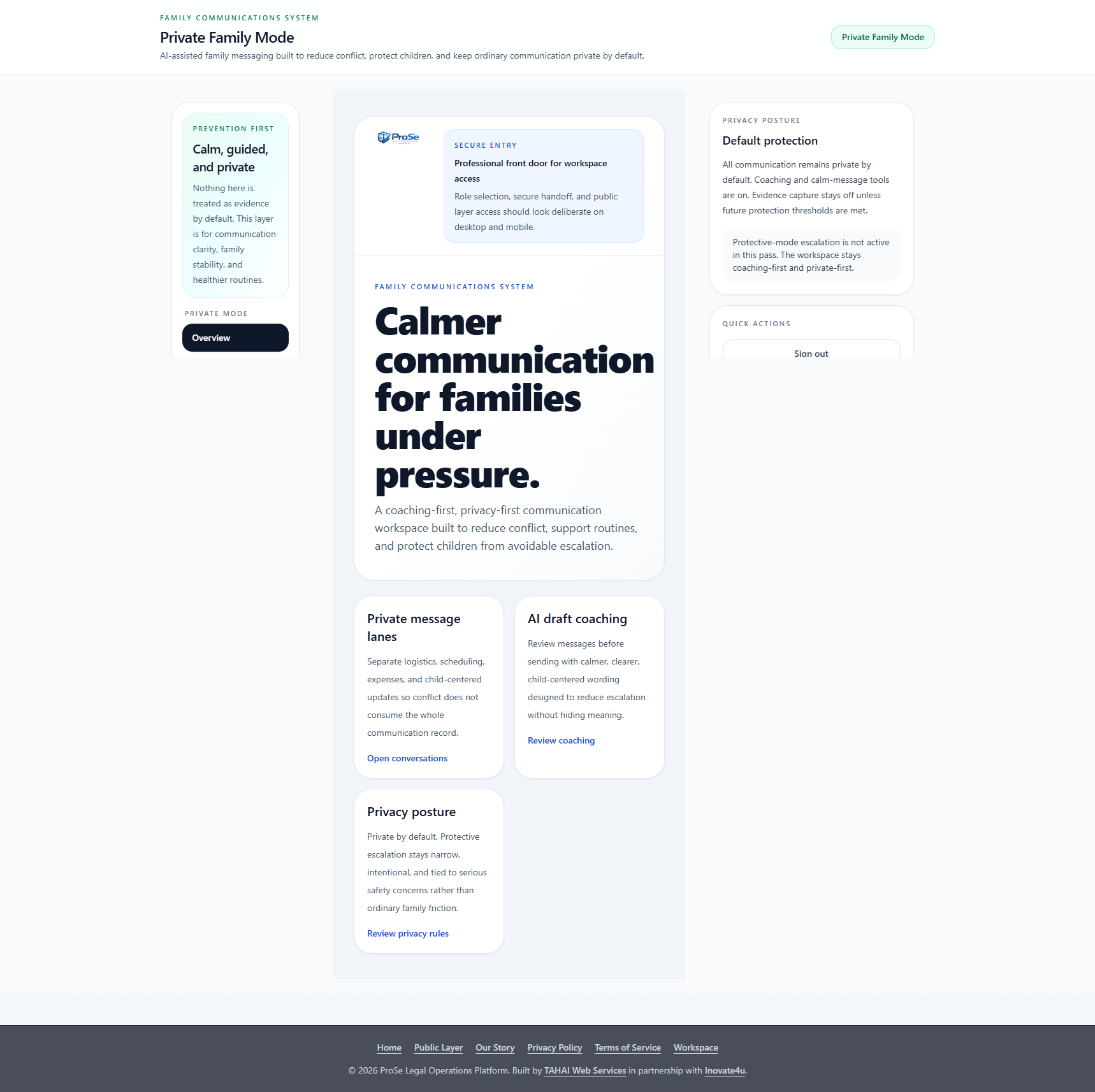
This public link goes to the broader fairness page, while the screenshot below shows the private-family-mode direction now being built: calmer message lanes, AI draft coaching, and a privacy-first posture meant to reduce escalation instead of feeding it.

Preview

Private Family Mode preview

Click the image to open a larger view for easier reading, then use the fairness page for the public-facing explanation of why a more structured family communication layer matters.

Screenshot preview of ProSe Private Family Mode showing calmer communication for families under pressure, private message lanes, AI draft coaching, and privacy posture cards.
Public link + private preview

Family communications, framed as prevention first

The screenshot shows a privacy-first family mode built around calmer communication, routine support, and child protection by default. The linked fairness page explains the public accountability side without requiring sign-in.

Current family communication system options

People should be able to see what already exists before anything new is asked of them.

This is not here to sell an app. It is here to help families, helpers, and officials understand that structured family-communication systems already exist, that they use different models, and that people may want to compare privacy, message structure, calendar tools, expense tools, coaching features, and export/report options before relying on one.

Structured messaging + record tools

OurFamilyWizard

OurFamilyWizard presents itself as a co-parenting platform with messaging, scheduling, expense tracking, and court-accepted records. Its messaging pages emphasize permanent, time-stamped messages and professional visibility options.

Messaging + calls + payments

TalkingParents

TalkingParents offers secure messaging, recorded calling, shared calendar tools, accountable payments, and unalterable records. It is one of the most commonly cited structured communication systems in family-court settings.

Lower-cost all-in-one lane

AppClose

AppClose markets itself as a co-parenting platform with messaging, calendars, records, calling, and export options. It is often mentioned because it provides a lower-cost entry point than some long-established platforms.

Mediation-heavy lane

coParenter

coParenter centers its model around communication, check-ins, calendar tools, and mediator involvement. It is useful to note because it is not just a message archive; it also builds in conflict-resolution support.

Calendar + expense + message lane

2houses

2houses focuses on calendars, expenses, messaging, shared information, and document storage. It is another established option for families who want structure without every tool being built around the court-record posture first.

Use this list as a help-first comparison door

Compare the communication model before you choose the tool.

Families under pressure do not all need the same thing. Some need stricter records, some need calmer coaching, some need better scheduling and expense coordination, and some need a privacy-first space that does not treat every ordinary family contact like evidence by default.

Week planning sheet

Keep the child's next seven days in one calmer place.

A lot of family pressure is not one giant event. It is a crowded week: school notes, appointments, supplies, provider follow-up, transitions, backup plans, and the next message that needs to be sent. Start with one simple week sheet before you reach for every other tool.

Look only at the next seven days.

Do not try to solve the entire month. Write down the school points, appointments, handoffs, supplies, and child-impact notes that matter between now and the end of the week.

Choose the top three things that cannot slip.

This keeps the week realistic. Once those are visible, decide who needs a message first and what support contact or backup plan should be ready.

Then pull only the smaller tool the week actually needs.

After the week is visible, move into the routine tracker, school + care team sheet, communication log, transitions planner, support circle sheet, or message starters only where the child's week is tightest.

Portable planning tool

Use one planning sheet before opening five different files.

This is useful at the start of the week, before a difficult handoff, or anytime school, appointments, supplies, and communication all need to stay visible at once.

Top three this week

Use one small card when the week needs priorities more than detail.

This is the lighter step before a full snapshot or reset sheet. Use it when the child's week feels crowded, but the most helpful move is still to narrow the field: the main need, the next must-do, and the next person or system that matters.

Name the child's main need first.

Put the need at the top that would most improve the child's week if it were handled well: school support, sleep, transportation, medication, provider follow-up, or a calmer handoff.

Choose the next must-do.

Write down the next thing that cannot be missed. A small card works best when it protects one truly important next step from getting buried under everything else.

Choose the next contact.

Keep one name, role, and deadline visible so the next message or call does not have to be reinvented from scratch.

Download

Carry the smallest useful page first.

The week priorities card is a child-centered planning aid for the next few days. Use it before the larger set when the real need is clearer priorities, not more paperwork.

Support circle

Keep the child's ordinary support network together when the week gets busy.

A steadier week often depends on having the right school contact, provider callback, childcare note, backup adult, or family helper visible before something slips. This section is about keeping the child's practical support circle in one place so parents are not rebuilding it from memory every time pressure rises.

List the adults who affect the child's week.

Start with school, childcare, medical or therapy providers, transportation support, and any trusted adult who may need the same practical update this week.

Keep one next-contact list, not five scattered ones.

Write down who needs the next message first, what they need to know, and what the child-impact point is. That makes school notes, provider callbacks, and pickup updates easier to send cleanly.

Pair it with the right shorter tool.

Use the support-circle sheet with the routine tracker, school + care team sheet, communication log, transitions planner, or message starters depending on what the child's week is asking for.

Portable support tool

Carry one sheet that keeps the child's real support circle visible.

This is useful when school, providers, childcare, transportation, and family backup help all matter in the same week and you need one calmer place to keep names, roles, and next steps together.

Protect child relationships

Reduce loyalty conflict and alienation-type harms in a child-centered way.

This lane is for weeks when the child is being pulled into sides, silence, denigration, messenger roles, or distance from safe relationships. It is not here to diagnose every strained relationship as “alienation.” It is here to reduce harmful conflict, protect stable routines, and keep safe relationships around the child from shrinking without a clear safety reason.

Keep the child out of the adult relationship.

Do not make the child carry messages, defend one adult, explain adult conflict, or keep adult secrets. That pressure is often one of the fastest ways a child’s world gets smaller and less safe.

Protect ordinary safe ties.

When school contacts, providers, grandparents, helpers, or one parent are important safe relationships for the child, do not let conflict casually cut them down or turn them into leverage.

Use lower-conflict tools first.

Shorter factual messages, steadier handoff notes, one clearer family communication lane, and a visible support circle usually help more than longer arguments.

Dedicated guide

Use the fuller relationship-protection page when this pattern is becoming part of the child’s week.

The dedicated page stays in the child-well-being lane and focuses on warning signs, what helps quickly, what not to do, communication systems, and a careful source trail.

How to choose a family communication system

Pick the communication model that matches the real family problem, not just the loudest brand.

Some families mainly need one clean record. Some need calmer scheduling and handoff coordination. Some need stronger coaching or mediated help. Some simply need a lower-cost place to keep messages, calendars, and child logistics together. A help-first comparison can keep people from paying for the wrong shape of tool.

Record-first lane

When accountability and exportable records are the main need

Families sometimes want a more rigid message record, time stamps, expense tracking, and formal reporting when conflict is high and ordinary texting keeps creating disputes.

  • Often prioritize uneditable message history
  • Usually emphasize reports, logs, and trackable requests
  • May feel more formal, which helps some families and wears on others
Coordination-first lane

When the pressure is mostly calendars, school, expenses, and handoffs

Some families mainly need fewer missed details: pickup changes, shared schedules, school information, expense splits, and one place for ordinary child logistics.

  • Best when friction is practical more than explosive
  • Useful for school, activity, and care-team coordination
  • Can be easier to adopt when a family wants structure without every screen feeling adversarial
Coaching or mediation lane

When the family keeps getting stuck at the same conflict points

If the main issue is repeated breakdown around exchanges, requests, or communication tone, a model with more active coaching or mediator involvement may be more useful than a pure archive.

  • Can help families resolve recurring disputes faster
  • Useful when the need is not only record keeping
  • May be less appealing if the goal is just a light shared tool
A calmer rule of thumb

Choose for the child's week, not just the adult fight.

Before paying for anything, ask which problem most needs relief: message conflict, exchange friction, schedule confusion, expense disputes, provider coordination, privacy, or the need for a cleaner family record. The better the match, the less likely the system itself becomes one more source of stress.

Child-needs snapshot

Use one page when the week is touching everything at once.

Sometimes the child's week is not one neat problem. It is school plus a provider callback plus a handoff plus a pickup change plus one message that still has to go out. Start with a one-page snapshot before you decide which longer tool you actually need.

Put the main need at the top.

Name the child's most important need this week first. That keeps the page grounded in the child instead of the adult churn around the child.

Keep the next follow-up visible.

Write down the next school, provider, or care-team contact and the next transition or handoff that needs attention.

Keep one backup plan close.

Note the first trusted adult, backup pickup option, or support person who matters if the week changes again.

Download

Start with the simplest page first.

The child-needs snapshot is a calmer first step when the right move is to steady the week before reaching for the bigger packet shelf.

Source trail

Keep the official source and public research close.

Maine law

19-A section 1653

The Maine statute sets the best-interest standard, says safety and well-being are primary in residence and parent-child-contact decisions, and lists factors A through S.

CDC

Adverse childhood experiences and prevention

CDC materials explain the harms linked to adversity and the value of safe, stable, nurturing relationships and environments.

DOJ OVW

Domestic-violence context and safety

OVW materials frame domestic violence as a pattern of abusive behavior and note the serious effects on children who witness violence in the home.

Keep moving

Use the guide, then move into the next practical lane.

Prepare

Sort the file before the next date gets closer.

Use the organization and hearing-week pages once you know which factors matter most.

Safety

Do not use this page to talk yourself out of urgent help.

If the pressure is immediate, move into crisis and official-help doors first.

Proof

Keep the public record nearby.

When the question becomes systemic rather than case-specific, move from this guide into the dashboard and evidence center.

Relationship-protection quick route

Use the smallest honest guide that fits the child's week before you open the bigger lane.

This quick route is for live weeks: a rough exchange, messenger pressure, quiet cutoff from safe people, or school/provider strain.