Power without learning
No one needs a law degree to be a decent co-parent. But a person who repeatedly seeks coercive relief cannot treat the meaning, implementation, and consequences of that relief as somebody else’s homework.
This is not a neutrality exercise and it is not a criminal accusation. It is a source-linked public accountability record built from 81 deduplicated conduct anchors, 24 public-safe direct-communication exhibits representing 31 native Gmail messages, the February 11 order, and a searchable 395-entry master timeline. The central question is blunt: when adults retained control over logistics, transportation, records, portals, money, and access, why was responsibility repeatedly pushed onto the child while the consequences were pushed onto the father?
The recurring effect was practical control without practical responsibility. Adult implementation questions were repeatedly converted into child-discretion questions while the surrounding conditions of contact, scheduling, transportation, medical access, school information, money, and therapeutic follow-through remained controlled by adults and institutions. In Justin A. Tahai’s opinion, that is not responsible parenting. It is lowlife conduct wrapped in procedure.
That conclusion is a source-based public-accountability inference—not a contempt finding, diagnosis, or adjudication of motive.
Five surviving enforcement lanes, nine top-level factual questions, 36 proof-specific questions, and eight advocate-witness screening topics. Public-safe source-navigation edition; not a ruling or ethics finding.
The integrated August 21 objection analysis places the child's stated wishes beside the sixteen-year access history, prior neutral concerns, current evidentiary limits, and the adult logistics required to make the February 11 order operational.
SIGNED OPINION · PUBLIC ACCOUNTABILITY · NOVEMBER 14, 2026
Amanda Morse has had sixteen years to learn how to communicate with the father of her child, understand the court machinery she repeatedly invokes, and carry the adult share of implementing orders that shape a child’s relationship with both parents. The record below does not prove every allegation. It does show practical adult control repeatedly paired with adult evasion, child-choice deflection, incomplete information, counsel-filtered communication, and demands that other people absorb the consequences.
You do not get to use a child as the gatekeeper, use the court as the muscle, use ignorance as the excuse, and then use support as the invoice.
No one needs a law degree to be a decent co-parent. But a person who repeatedly seeks coercive relief cannot treat the meaning, implementation, and consequences of that relief as somebody else’s homework.
An adverse finding against Justin remains part of the record. It does not transform every act by Ms. Morse into wisdom, every refusal into protection, or every disputed choice into responsible parenting.
A support order may be legally enforceable while the moral and economic history remains contested. A weekly invoice is not a certificate of good character and does not erase alleged alienation or career damage.
A teenager’s feelings matter. That does not make the teenager responsible for adult scheduling, transportation, records access, court interpretation, therapeutic follow-through, or the preservation of a parent-child relationship.
“Lowlife conduct” is Justin A. Tahai’s moral and political opinion. It is not a criminal charge, diagnosis, or substitute for proof. His opinion is that knowingly or carelessly shifting adult responsibility onto a child, resisting scrutiny, and seeking financial benefit from the resulting arrangement is beneath the minimum standard of responsible adulthood.
/s/ Justin A. Tahai
Father · Engineer · Author · opinion and public-accountability commentary
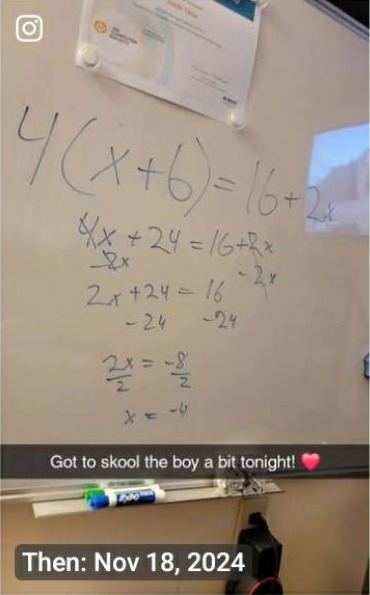
DATED IMAGEAUTHOR ACCOUNTNOT A FINDING
An ordinary evening, captured in an ordinary photograph, of a father teaching his son algebra.
The dated image is a concrete counterexample to a flattened narrative in which the father appears only as a problem. It supports the author’s account that he was actively teaching and encouraging his son. It does not, by itself, prove Morse’s motive, alienation, abuse, or any disputed legal conclusion.
Evidence ID: FTH-2024-11-18-ALGEBRA
Underlying date displayed: November 18, 2024
Source SHA-256: 1626a690e9572f7939c1a9e04ae14b13335d954ac8b72a5f651ec09f95b063e8
November 2025 warning · August 2026 FM-218 · November 2026 FM-218 addendum
The warning was not invented after the damage compounded. It was put in writing before the present year of implementation failures. The expedited-hearing requests were not vague. They identified contact, reunification therapy, records access, adult logistics, school and medical issues, and the danger of allowing delay itself to harden the status quo while a child kept growing older.
The cover letter accompanying a motion to amend stated that captioned copies were being sent to the Maine Senate, Governor Mills, and Chief Justice Stanfill. It then warned:
“Without significant changes, and for as long as such a backlog exists, there will always be those who take advantage to alienate children from their other parent. Simply throwing more resources into such adversarial systems will not help our society, it can only continue to harm it.”
The letter ended: “Senators, Governor Mills, and Chief Justice Stanfill — shame on you; do better.”
The signed form stated that ongoing failure to implement contact, reunification therapy, records access, and adult logistics was hardening the status quo and transferring adult conflict to the child.
“The February 11 Order provides daily electronic contact and phased in-person contact, but implementation remains disputed and incomplete despite specific written notice and formal motions.”
It also stated that a forty-eight-hour good-faith response deadline had expired on February 18 without a complete response.
The latest addendum requested the earliest lawful three-hour hearing because tax and disclosure issues remained unresolved, weekly therapy was not operating consistently, daily electronic and staged in-person contact remained disputed, and school and records issues were current.
“The child is nearing the end of minority; and the delay itself destroys the subject of the relief.”
It requested a written order identifying every issue granted, denied, deferred, precluded, or reserved.
Backlog is not neutral when one adult controls the practical conditions of access. It becomes leverage. Silence becomes time. Time becomes a hardened status quo. And a hardened status quo becomes the excuse for still more delay.
Justin A. Tahai’s signed position is that he tried politeness, written notice, defined response deadlines, the required forms, and repeated requests for neutral intervention. He contends that government delay then gave Ms. Morse nearly another year in which alleged nonimplementation, child-gatekeeper framing, and damage to the father-son relationship continued.
He characterizes that continuing pattern as relational abuse of both father and son. That characterization is his allegation and moral opinion, not an adjudicated finding. In his opinion, knowingly exploiting or benefiting from delay while a child-parent relationship deteriorates is selfish, scumbag conduct.
Source boundary: the November 21 letter proves the warning was made; the FM-218 filings prove expedited relief was requested and explain why. They do not, by themselves, establish contempt, deliberate alienation, motive, or legal liability. Justin reports no substantive institutional correction responsive to the warning before the later harm and delay he alleges. Official orders, hearing audio, testimony, and native records control disputed facts.
November 14, 2026 · signed editorial update
No one enters family court fluent in every term. That excuse expires when a person repeatedly asks the court to restrict another parent, controls the practical implementation of contact, and then treats basic comprehension as optional. In my opinion, the pattern is not innocent confusion. It is adult responsibility avoided on demand: counsel supplies the vocabulary, the court supplies the coercive power, the child carries the conflict, and everyone else pays the bill.
Willful ignorance is not harmless when it is paired with control over another person’s child, livelihood, records, access, and family life.
Justin A. Tahai reports that, during the enforcement hearing, Ms. Morse stated on the record that she did not understand the words he was using. After sixteen years of litigation, the answer to unfamiliar language should have been to ask, learn, and respond—not to remain intellectually disengaged while continuing to exercise practical control over the consequences.
Source status: This is the author’s recollection of testimony. No public transcript or audio excerpt is included here, so the official recording or transcript controls the exact wording and context.
At the consolidated final hearing, Attorney Bedard questioned Ms. Morse about imputed income. Justin A. Tahai recalls that she did not understand the term. The word matters because the court later used imputation to assign earning capacity and impose a support obligation.
The signed February 11 order confirms that the hearing occurred and that the court imputed full-time, minimum-wage earning capacity of $30,200 annually to each party.
Source status: The hearing and the imputation are confirmed by the signed order. The claimed exchange about her understanding is the author’s recollection pending publication of the audio or transcript.
Justin’s position is not that misunderstanding a word makes someone immoral. His position is that refusing to learn while invoking the system against another person—and then expecting the child, counsel, courts, and opposing parent to manage the consequences—is morally contemptible.
Documented anchors + signed first-person account · November 14, 2026
A signed March 22, 2024 employment offer placed Justin A. Tahai in an Engineer II, Managed Services role at $33.65 per hour—approximately $69,992 annually at forty hours per week. That documented baseline was more than twice the later $30,200 imputation.
Justin further reports that during November and December 2024 he completed several interviews with a large Portland-area corporation for an IT Manager role carrying a stated compensation range of approximately $90,000 to $100,000. He reports that, out of hundreds of applicants, he reached the final three candidates—even while he had already lost approximately twenty pounds by that point and was barely getting out of bed most days.
That was not the full physical decline. Justin clarifies that the approximately twenty-pound figure describes his condition during the interview period. He reports that his total weight loss ultimately reached approximately thirty-five pounds.
“Fourteen years of repeatedly having my child taken from me following accusations I contend were grossly exaggerated or blatantly false can wear on a father.”
/s/ Justin A. Tahai
Justin presents that statement as a cumulative-harm account—not as a claim that one hearing, one allegation, or one person independently caused every health, career, and housing consequence. His account is that repeated father–child separation, prolonged litigation, recurring accusations he disputes, financial strain, and the continuing need to defend his fitness as a father wore down his health and ability to function over time.
That opportunity was not merely a better paycheck. It represented restoration of professional momentum, financial independence, and, in his account, the realistic prospect of having his own home again.
Source status: The $33.65 hourly rate, the $69,992 annualized calculation, the $30,200 imputation, and the $100 weekly obligation are documented. The Portland-area employer, interview sequence, final-three standing, $90,000–$100,000 range, approximately twenty pounds lost by the interview period, approximately thirty-five pounds lost in total, functional condition, fourteen-year cumulative toll, causation, disputed characterization of accusations, and home-ownership prospect are Justin A. Tahai’s signed first-person account. No employer correspondence, medical record establishing causation, or offer for that role is presently published on this page.
The February 11 order states that Mr. Tahai had a professional background in information technology and cybersecurity, could work, and had voluntarily left his last job after being passed over for promotion. It then imputed full-time minimum-wage earning capacity and ordered weekly support. That is the court’s finding and remains part of the record.
Mr. Tahai’s February 16 implementation notice supplied the competing economic account: a pending criminal matter listed as “awaiting disposition” on comprehensive background checks materially limited access to roles involving enhanced screening and sensitive data, while active litigation consumed time otherwise available for rebuilding income.
The court can calculate support. It cannot honestly reduce the moral story to a weekly number while ignoring the disputed destruction of the career, independence, and home that number was supposed to come from.
The February 11 order found abuse by Mr. Tahai. This page does not erase, relabel, or conceal that finding. It also does not permit the finding against one parent to function as blanket exoneration of every disputed act by the other. Contact implementation, records access, alleged alienating conduct, financial disclosure, and economic consequences must each be examined against their own evidence.
Justin reports that, during the October 8 hearing, Ms. Morse invoked his arrest, incarceration, and abuse finding as though she “had him jailed for being abusive.” The exact words and context remain subject to the official audio or transcript. Even if accurately recalled, that statement does not answer scrutiny of her own conduct. Being harmed does not confer a moral license to harm others.
His allegation that Ms. Morse intentionally contributed to alienation between father and son remains an allegation and public-accountability conclusion—not a court finding. But an adverse finding against Justin is not a halo for Amanda Morse, not a parenting award, and not immunity from examination.
In my opinion, using an adverse finding against me as a universal excuse, refusing examination of alleged alienation, and then seeking support from the earning capacity damaged during the same conflict is lowlife conduct. It is a child in the middle, a career in the ditch, and an invoice presented as virtue.
Before treating the support obligation as a clean moral ledger, consider the actual sequence: years of schooling, substantial educational debt, entry into a technical career paying more than double the court’s imputed figure, a reported final-three opportunity at $90,000–$100,000, loss of that trajectory amid criminal and family-court consequences, diminished access to screened IT roles, and then additional compulsory financial obligations calculated from a minimum-wage fiction.
Ms. Morse should understand what that burden means: return to school for years, accept substantial debt to build a new career, establish professional momentum, lose the career path amid coercive conflict with an ex, lose the realistic prospect of an independent home, and then be ordered to finance the arrangement that followed. Inflicting reciprocal damage would not be justice. Refusing to reward obstruction or alleged alienation, accounting honestly for economic harm, and restoring the father-child relationship would be.
You cannot help destroy the earning capacity, demand payment from what remains, and call yourself the responsible parent.
/s/ Justin A. Tahai
Opinion and public-accountability commentary
Not knowing one word is not a moral failing. Refusing to learn what is necessary while exercising practical control over a child’s relationship, records, transportation, scheduling, and access is an accountability failure. A person cannot demand that courts take her claims seriously while treating the concepts, orders, and consequences behind those claims as somebody else’s homework.
Justin A. Tahai’s opinion: Ms. Morse did not want to do the work of learning. She wanted counsel to translate, the court to coerce, the child to carry the conflict, and the other parent to absorb the damage. She should have learned to communicate like an adult. In his opinion, she chose ignorance, avoidance, accusation, and coercive conflict instead. She owns the public accountability record created by those choices now.
Ignorance becomes cruelty when someone else is forced to live with its consequences.
/s/ Justin A. Tahai
Opinion and public-accountability commentary
October 31, 2026 · new adult correspondence audit
The historical case record begins in 2010. The new October messages show canceled counseling, an invitation from Daniel Pierce to restart future sessions, requests for adult logistical decisions, replies about school notification, and a separate complaint about receiving a civic notice around midnight. The father argues these exchanges continue a pattern of obstruction and disparagement. The messages document what was written; they do not, by themselves, establish deliberate alienation or disprove the court's adverse findings. A further written contrast deserves direct review: Ms. Morse stated on October 26 that she was “not standing in the way,” while earlier messages made in-person scheduling contingent on her assessment of compliance or the teenager initiating it. The court’s own conditions and the child’s preferences remain part of that analysis.
The therapist canceled future standing reservations and invited a restart request.
Ms. Morse criticized email volume and also articulated her view of shared responsibility.
A reply criticized the hour and content of a public email, distinct from scheduling inquiries.
The original late-night response concerned a public notice—not a contemporaneous therapy scheduling request. Prior exhibits also show provider-facing cooperation by Ms. Morse, the author's own sharp wording, and a denial of exposing the child to litigation material. Each belongs in a fair record.
The evidence remains the backbone. The carnival is the accusation in visual form: adult gatekeeping, blame loops, delay, and a child repeatedly treated as the practical stop sign while the adult holding the logistics disclaimed responsibility. In Justin’s opinion, the spectacle is grotesque because the cost was real childhood, real work, real health, and a real father-son relationship.

This image presents the author’s process critique in metaphorical form: the word “abuse” can operate like a skeleton key in family litigation—opening restrictions, delay, presumptions, and narrative control long before contested facts receive durable scrutiny.
That is an argument about incentives and process. It is not a declaration that every allegation is false.
One booth hides the oversized skeleton key. The others conceal familiar outcomes: delay, blame, proof barriers, and gatekeeper framing. Commentary only—but close enough to the recurring structure to make the point.
Hook set. Keep scrolling for the rides, the scoreboards, and the source-linked record that the satire is built around.
THE MIDWAY AFTER DARK • BOOTH 14
Three balls. Two racing meters. One THROW button.
# Game link
GAME COMPLETE
EDITORIAL SATIRE, NOT EVIDENCE. Drowning in Shelfishness is original editorial satire using a generic carnival figure, not a likeness or photograph. The game illustrates the publication’s stated themes of responsibility-shifting, adult implementation, and record accountability. It is not a diagnosis, judicial finding, or claim of literal conduct beyond the cited source record.
Guest heckler: user-supplied editorial clown artwork. “INACCURACY!” is fictional game dialogue, not a quotation or recording of any person.
A LITTLE TIMING. A LOT OF SPLASH.
Prefer an untimed game? Turn on Practice assist and set both sliders to 50. This also works with a screen reader.
Space / Enter play · R restart game · M sound · Esc close. Shortcuts only apply while focused inside this game.
Reset session resets this visit only. Your best score and existing arcade progress are kept.
The point is not to replace the record. It is to make readers curious enough to continue into the chronology, the direct communications, and the implementation audit.
The author’s claim is that the adults held the practical keys—transportation, notices, scheduling, and gatekeeping—even while responsibility was repeatedly assigned elsewhere.
Keep scrolling for the mid-page ride panels, two restored midway games, and the final clown-and-teeth booth near the bottom.
This is Justin Tahai's source-linked public-accountability record. It alleges a long-running pattern of interference with shared parental rights, adult nonimplementation, and disparagement. It does not claim that every timeline entry or email has been adjudicated as contempt, nor does it erase reciprocal conflict or contrary clinical evidence.
It compares the operative order with direct written positions, preserves dates and source types, makes the full public-safe chronology searchable, and identifies the practical consequence of adult control over scheduling, transport, information, and access.
The thesis is direct: a child can have a meaningful voice without becoming the sole scheduler, legal interpreter, enforcement mechanism, or public excuse for adult nonimplementation.
No child name, birth date, private phone number, residential address, private email address, anonymous-account theory, appearance commentary, diagnosis, or invitation to contact, shame, threaten, surveil, or pressure Ms. Morse or anyone around the child.
Direct quoted messages from the minor are omitted from the web timeline. Native records remain controlling.
Across direct emails, official orders, filings, provider and school records, and the no-loss timeline, four conclusions are sufficiently supported to organize the public record. They remain public-accountability conclusions, not substituted judicial findings.
Requests for a recurring contact window, a confirmed visit, replacement time, or a workable adult plan repeatedly received child-discretion, child-choice, or child-refusal answers.
Adults and institutions controlled transportation, notices, portals, provider access, school enrollment, scheduling, and legal interpretation; the child was nevertheless positioned as the decisive gatekeeper when implementation failed.
The record reaches electronic contact, in-person progression, therapy, individual-support recommendations, medical and dental participation, school information, communication restrictions, and repeated enforcement work.
Ms. Morse sometimes supplied useful information or coordinated a reschedule. Daniel Pierce raised real concerns about message volume. Justin also used pointed language. None of that erases the implementation questions; omitting it would weaken them.
The record supports scrutiny of an operating model in which the child’s preferences were treated as decisive while no equally concrete adult implementation structure was made visible in the record. The unresolved legal question is not whether the child had a voice. It is whether that voice became a substitute for the adults’ duty to implement, clarify, seek modification, or obtain a prompt ruling.
The full master timeline contains 395 entries. This narrower ledger removes unrelated eFiling and transcript events and keeps the entries that directly concern contact, adult facilitation, therapy, medical or school access, communication restrictions, and documented disparagement or undermining allegations. Repeated filings that describe the same underlying episode are not treated as separate proven acts.
Direct email proves what was written. A filing proves what was asserted or requested. An official order proves the order or docket event. A provider or school record proves what appears in that third-party record. None of those categories automatically proves motive or contempt.
The filtered ledger is a reading aid, not a replacement for the no-loss master timeline. Every selected item retains its master-timeline ID, source page, source class, and limitation statement.
The atlas groups repeated sequences without pretending that repetition alone proves motive or contempt. Each pattern states its signal, source anchors, and limiting proposition.
Contact logistics were repeatedly returned to the child instead of converted into an adult-confirmed time, platform, or fallback.
Limit: This proves the written operating position. It does not prove why the child did not respond or what level of facilitation the order legally required.
In-person contact was stated to be unavailable until Ms. Morse personally saw proof that preconditions had been met.
Limit: The messages do not decide whether the conditions were satisfied or who had authority to decide compliance.
A provider-confirmed therapy/contact session was displaced, then adult make-up proposals were answered through child-control language.
Limit: Driver education was legitimate. The accountability issue is the adult response to preserving or replacing the lost therapeutic/contact time.
Holiday and ordinary contact requests were answered by reporting the child’s refusal, without a documented adult facilitation plan.
Limit: The record does not establish how the request was presented or why the child declined.
Medical and dental participation required follow-up for time, location, portals, records, or a disputed PFA interpretation.
Limit: The records prove the notices and disputes, not motive or the final legal scope of attendance rights.
Implementation and child-impact correspondence was repeatedly characterized as ridiculous, rambling, tantrum-like, unread, or unnecessary.
Limit: The father’s volume and sharp language are part of the same record and must remain visible.
As implementation failed, the record grew; the volume of the record then became a separate criticism of the person trying to preserve it.
Limit: Clinical concern about volume is real and is included. It does not erase the underlying implementation questions.
One anchor may appear in more than one category. These bars measure issue density, not separate proven violations.
A direct email proves what was written. A filing proves what was asserted. An official record proves the official event. The page does not collapse those categories.
This matrix separates the legal expectation from the practical levers that determined whether the right could operate in real life.
| Domain | Order expectation | Practical control | Record signal | Unresolved question |
|---|---|---|---|---|
| Electronic contact | Reasonable daily contact at reasonable times. | Availability, device access, response environment, and any recurring time window. | Repeated requests for a defined time and platform; replies placed contact at the child’s discretion. | What affirmative adult facilitation, if any, was required when the child did not initiate or respond? |
| In-person contact | A contingent minimum progression beginning no later than the stated deadline. | Transportation, proposed dates, adult confirmation, public location, and make-up time. | Contact conditioned on Ms. Morse seeing proof; later described as solely the child’s decision. | Who had authority to determine compliance and what was the cure if the parties disagreed? |
| Therapy / reunification | Regular therapeutic work and a pathway toward relationship repair. | Scheduling, punctual transportation, full session time, and replacement of displaced sessions. | A confirmed session was displaced; make-up proposals produced the “sole gatekeeper” exchange. | Should lost sessions have been automatically replaced, and was individual therapy ever implemented? |
| Medical / dental | Shared records access and ordinary parental participation except where lawfully limited. | Appointment notice, time/location, provider listing, portal credentials, authorizations, and on-site logistics. | Incomplete physical notice, disputed PFA attendance bar, dental concern, and portal mismatch. | What direct access was actually restored, and what neutral logistics could have protected everyone? |
| School information | Direct access to school records and important information. | Parent-portal enrollment, annual update, attendance notice, and direct school communications. | Repeated requests for direct access and records while attendance/tardiness issues were documented. | Was each parent independently listed and able to receive notices without the other parent acting as gatekeeper? |
| Adult communication | Prompt, respectful responses and no disparagement around the child. | Whether messages are read, answered, routed through counsel, or threatened with PFA reporting. | Replies included shutoff language, personal insults, and a threatened police/PFA route for ordinary email. | What narrow communication protocol would preserve necessary co-parenting without recreating an uncontrolled email war? |
The sequence does not erase adolescent autonomy. It identifies the repeated written movement from adult implementation requests to child-discretion answers.
Contact described as the child’s discretion and comfort level.
Core Ex. 01A requested daily call time was directed back to the child; original text contains an apparent typo.
Supp. Ex. 19No in-person visit until Ms. Morse saw proof of compliance.
Core Ex. 02Father could call or text “if he chooses to speak.”
Core Ex. 03All electronic or other contact again placed at the child’s discretion.
Supp. Ex. 22The child described as the “sole gatekeeper” of contact and frequency.
Core Ex. 04In-person contact described as a decision the child could control on his own.
Core Ex. 05A holiday request answered only with the child’s stated refusal.
Core Ex. 08Ms. Morse stated she could not force a reply.
Core Ex. 09No in-person progression because Ms. Morse had seen no proof of compliance.
Core Ex. 11No affirmative adult role accepted; responsibility and blame returned to the father.
Core Ex. 16The expanded record adds eight supplemental communications to the sixteen core exhibits. It includes adverse messages, mixed messages, and counter-record showing useful coordination. Every card states what the message proves and what it does not.
He has the one phone number that you have. He has no video platforms. If he is not messaging you back, it's because he does not want to. He's almost 16 years old, I am not going to dictate his time. This communication is at his discretion and what he is comfortable with. Please stop bombarding me with ridiculous emails. Thanks, Amanda
The reply followed a dated list of unanswered text, photo, and call attempts and a request for an approved number, platform, and reasonable daily time window under the February 11 order.
Directly records a written child-discretion position and the response to a logistics-focused request. It does not establish why the child did not respond or whether any particular facilitation measure was legally required.
Native Gmail message in the account of Justin Tahai; sender-authenticated Gmail metadata; public-safe derivative.
I have seen no proof of the things you were supposed to have done before an in person visit. Therefore, one will not take place until I do.
The reply followed a request to identify a workable date and time before the stated March 13 contact deadline, with an offer to coordinate through the reunification therapist.
Directly records that contact was being conditioned on Ms. Morse's receipt or review of proof. It does not decide whether the conditions had been satisfied or who had authority to determine compliance.
Native Gmail message; public-safe derivative.
You can text or call him anytime today, if he chooses to speak with you.
The statement was sent during an active dispute over how the February 11 order's daily electronic contact and in-person progression would be implemented.
Directly records conditional language. It does not establish whether the child was available, willing, or being affirmatively encouraged to participate.
Native Gmail message; public-safe derivative.
He's a rational, independent, level headed 15 year old boy who is learning how to prioritize, be responsible and make his own decisions. You have to let him. You can ask him about this weekend all by yourself. You do not need me to mediate. If you feel that you do need me to be a buffer in your communication with [the child] then it's not time for in person contact to start. That is going to be solely his…
A provider-confirmed therapy/contact session was displaced by a driver-education appointment. Justin did not object to driver education and proposed either direct weekend time or a prompt make-up session. The messages above are assembled from three replies in the same sequence.
This is the clearest direct-writing anchor for the disputed child-as-gatekeeper interpretation. The official order controls; the exhibit does not decide whether Ms. Morse's reading was legally correct.
Three native Gmail messages in one thread; public-safe derivative.
To reiterate, it is not a burden being put on [the child] whether or not to have in person contact. It is a decision that he is able to make and have control of on his own. If he tells me that he wants in-person contact, I will gladly assist in scheduling. He has not wanted to. I will not force him to comply until you have complied with the terms of the order needed for in person contact to begin. I did…
The reply followed a request to preserve, replace, or make up a displaced therapy/contact opportunity and to address an individual-counseling recommendation. The native thread contains the full wording of both sides.
Directly records both the child-control position and the threatened police/PFA response to non-emergency email. It does not decide whether any email violated a protection order.
Native Gmail message; public-safe derivative.
Please stop putting not only our child's life in danger, but my younger child's life as well with your erratic driving. Control your emotions like an adult and stop endangering innocent people.
The reply followed a short logistics message stating that the child was outside waiting for the adult who had driven him. The public record presently available for this packet does not adjudicate the driving accusation.
Proves the accusation and tone were transmitted. It does not prove the accusation true, and the page labels it as disputed and unadjudicated.
Native Gmail message; public-safe derivative.
[The child] decided not to switch dentistry providers. His initial concern with going was that you would show up, however he has since seen them and been comfortable.
The statement was sent as a standalone update concerning dental care.
Directly records what Ms. Morse attributed to the child. It does not establish the source, accuracy, or cause of the reported concern.
Native Gmail message; public-safe derivative.
[The child] has stated that he doesn't want to go. Thanks.
The reply followed a written holiday request seeking a clear adult answer and logistics for a July 3 fireworks outing.
Directly records the adult response and child-choice framing. It does not establish how the question was presented, what support was offered, or why the child declined.
Native Gmail message; public-safe derivative.
He is not being exposed to anything. He hasn't seen any emails, motions, etc. and we don't talk about you at all. Around him or otherwise. His contact information remains the same. I cannot force him to reply to your messages. -Amanda
The reply followed a demand for concrete parent-child contact and a request that the child not be exposed to adult litigation, blame narratives, or disparagement.
Directly records a categorical denial and the stated practical limit. The email does not resolve credibility or what affirmative facilitation occurred.
Native Gmail message; public-safe derivative.
Please stop sending these to me. I really don't care. It has nothing to do with [the child]. I just don't care about your ramblings. If it is directly about [the child], I care.
The first reply was to a public-article courtesy notice. The second reply expressly clarified that the statement was about the article and "ramblings," not indifference toward the child.
The two messages must be presented together. The isolated first sentence must not be represented as an admission that Ms. Morse does not care about the child.
Two native Gmail messages in the same thread; public-safe derivative.
There has been no proof of compliance with paragraphs 1-3, therefore the in person contact hasn't moved forward...
The reply followed a request for two specific visit dates and a written position that adults, rather than the child, should schedule and facilitate the minimum contact contemplated by the order.
Directly records the asserted reason for non-progression. It does not decide whether compliance had occurred or whether Ms. Morse had unilateral authority to withhold progression.
Native Gmail message; public-safe derivative.
I speak with Dan periodically by phone, so he has no reason to meet with me. Thanks, Amanda
Justin had invited Ms. Morse to participate in a clinically supervised conversation and offered to wait outside or remain out of the session if the therapist considered that appropriate.
Directly records the stated reason for not attending. It does not establish whether the provider requested or recommended her attendance.
Native Gmail message; public-safe derivative.
The appointment is at 10:30 a.m. at the provider office. You will not be able to attend per the current PFA order.
The reply followed requests for the time, location, confirmation of attendance, and direct provider listing. The provider location has been omitted from this public derivative.
Directly records a categorical legal position. It does not decide the proper interpretation of the PFA or family order; the operative orders control.
Native Gmail message; public-safe derivative.
Not for nothing, I'm not going to take parenting or maturity advice from you. Clearly it's not working. Parenthood has nothing to do with your online ramblings. If/when you bring up an actual issue that needs addressing, it will be addressed. Your tantrums about the court system and you not getting your way, as well as your opinions about what the order should say or mean is not that. If you want to…
The exchange began with a request to make clear that time with extended family did not substitute for direct father-child contact. Justin later responded with his own pointed criticism and a long list of asserted implementation issues. The native thread contains both sides.
Directly records personal characterizations and blame allocation. It does not decide the merits of either party's account or whether any statement was heard by the child.
Two native Gmail messages in the same thread; public-safe derivative.
Considering he didn't know you were planning to go until you texted him had nothing to do with me. The fact he was uncomfortable with you being there had nothing to do with me. He's allowed to have feelings and to express them. Respect that. Once again, I said nothing to him. He read your text and called you. I HAD NOTHING TO DO WITH IT. Stop blaming me. I don't talk about you, discuss you or even mention…
These replies followed Justin's accusation that Ms. Morse had placed the child in the middle at a medical appointment. His messages used pointed language including "shame on you" and asserted that her embarrassment was earned. The public derivative therefore preserves the reciprocal tone context.
Directly records Ms. Morse's denial, blame response, and personal language. It does not identify the source of the child's belief or adjudicate who caused the medical-office conflict.
Two native Gmail messages in the same thread; public-safe derivative.
I wasn't aware that you had contacted him therefore I wasn't aware he hadn't replied. How exactly do you propose I keep track of this? Also, how do you propose I force him to reply? Even if I said, "Ok every day at 6:45 p.m., there will be the allowed electronic contact," how exactly do I force him to reply to a text or answer the phone? ... Please stop blaming me for the problems you've caused. I've had…
The sequence followed strongly worded accusations from Justin, including "get the hell out of the way" and criticism of Ms. Morse's reading comprehension. The packet preserves that reciprocal tone context rather than presenting the replies as unprovoked.
Directly records a refusal to assume the requested affirmative facilitation role, a limitation of adult-to-adult communication, blame statements, and personal language. It does not determine causation, contempt, or what the child experienced.
Three native Gmail messages in one thread; public-safe derivative.
Per my last email, twice a week would not be attainable at this time. Fridays have been rearranged to accommodate, so keep to that schedule. -Amanda
The reply followed a request to increase the frequency of reunification sessions after the school year. Work, transportation, and other obligations were part of the surrounding scheduling discussion.
Directly records a frequency limitation and a single-day schedule. It does not establish that twice-weekly sessions were clinically ordered, practically possible, or intentionally blocked.
Native Gmail message in the account of Justin Tahai; sender-authenticated metadata; public-safe derivative.
Hi Dan, I believe Justin has scheduled an appointment this Friday, 6/13, for 1pm. Unfortunately I just became aware of a scheduling conflict for that time. Do you have any other available time slots on Friday that we may be able to switch it to, providing Justin is also available? Thanks in advance, Amanda Morse
Ms. Morse wrote directly to the reunification therapist and copied Justin. The message sought an alternative time rather than simply cancelling the session. The native header timestamps the message at 9:08:12 p.m. on June 11 for a June 13 appointment at 1:00 p.m.—39 hours, 51 minutes, and 48 seconds in advance.
This cuts against any claim that every scheduling communication was obstructive and shows that direct coordination sometimes occurred. It also does not support the later counsel-relayed characterization that the written notice was “over 48 hours.” No earlier written notice was located in the retained Gmail account; an earlier oral notice or a message outside that account cannot be ruled out.
Native Gmail message; sender-authenticated metadata; public-safe derivative.
Text him and ask. I’m my forcing him. [Apparent typographical error preserved from the native message; the public record does not silently rewrite it.]
The reply followed a request for a confirmed call time between 6:00 and 8:00 p.m. under the February 11 order.
Directly records that the logistics request was returned to father-child communication rather than answered with an adult-confirmed time. The apparent typo prevents treating the final clause as unambiguous without the full thread.
Native Gmail message; sender-authenticated metadata; public-safe derivative.
He’s mad at you.
Justin had asked whether something had happened because the child’s messages appeared distressed and stated that he wanted to respond supportively. Direct quotations from the child are omitted.
Proves the terse adult response. It does not prove why the child was angry, what the child had said, or whether more explanation was available elsewhere.
Native Gmail message; sender-authenticated metadata; public-safe derivative.
[The child] went to the nurse this afternoon with stomach pain. He was sent home early. ... He just got into a room at the ER after a lengthy wait and having his vitals checked. All normal. We’re now waiting to see a medical professional. Thanks, Amanda [Selected minor health details omitted from the public derivative.]
Ms. Morse provided a contemporaneous update concerning a school-nurse visit, walk-in evaluation, and ER routing. Sensitive health details are not reproduced publicly.
This is material counter-evidence: it shows that useful medical information was sometimes provided promptly. It does not resolve later disputes about follow-up, portal access, records, or appointment participation.
Native Gmail message; sender-authenticated metadata; public-safe derivative.
1) His number is [private number omitted]. So if that is the number you have, it is correct. 2) There are no phone restrictions in place other than when he is driving with the instructor. ... 4) Any and all electronic, or otherwise, contact will be at [the child’s] discretion and within his comfort level. ... Respect his boundaries. -Amanda
The reply answered part of a four-item logistics request. It confirmed the number and stated that no general phone restriction existed, while declining to establish a daily time and again using child-discretion language.
Mixed evidence. It documents useful logistical information and the continued disputed implementation position in the same message.
Native Gmail message; sender-authenticated metadata; public-safe derivative.
[The child] is having his yearly physical scheduled 8/3 with Dr. Vinograd. Just fyi
The initial notice identified a date and provider but omitted the appointment time and office. Those details and direct provider access were requested afterward.
Directly proves the limited content of the first notice. It does not establish whether the omissions were intentional or whether all details were already available from another source.
Native Gmail message; sender-authenticated metadata; public-safe derivative.
Please Stop sending these to me. Seriously. I don’t read them. And they clog up my inbox. Refer them to my attorney and he can forward any deemed necessary. You’ve sent me 15 emails over a 6 hour span of of time. That’s ridiculous.
The reply followed a public-accountability message and stated that fifteen emails had arrived in six hours. The exact volume context is included because omitting it would make the refusal-to-read language misleading.
Proves the stated refusal, referral to counsel, and asserted message volume. It does not decide which messages were necessary, whether direct child-related communication could lawfully be refused, or whether the volume was reasonable.
Native Gmail message; sender-authenticated raw MIME and metadata; public-safe derivative.
Clear the search or select “All.”
The following evidence supplies cooperation, denial, autonomy, clinical caution, and reciprocal-tone context. It is included because the accountability claim should survive the complete record—not depend on selective quotation.
On March 31, Ms. Morse sent a substantive medical update while the evaluation was still occurring.
On April 13, the correct contact number and absence of general phone restrictions were confirmed.
On June 11, 2025, Ms. Morse asked the therapist for another Friday time and copied Justin. The located written notice preceded the June 13 session by 39 hours, 51 minutes, and 48 seconds.
Ms. Morse denied discussing Justin, emails, or litigation with the child.
Daniel Pierce expressed concern that the volume and perceived attacks could undermine relationship repair.
Several threads contain sharp criticism by Justin, including “get the hell out of the way,” “shame on you,” and attacks on reading comprehension.
The child’s age, feelings, independence, and therapeutic safety were legitimate considerations.
Many anchors are direct messages, filings, or source-navigation summaries rather than contempt findings.
That distinction matters. The Gmail record directly proves personal language sent to Justin. Historical GAL and party materials separately allege disparagement, undermining, secrecy, or adult blame around the child. The latter requires the native report, witness foundation, or adjudication; it cannot be inferred merely from a hostile email.
Limit: These quotes prove message content and tone. They do not prove the child saw them or that a court-order non-disparagement clause was violated.
Limit: These are source-navigation statements. The native GAL, clinical, or provider record controls and must be authenticated before courtroom use.
Limit: Clinical opinions and recommendations require their full context, scope, and privilege foundation. The page does not diagnose either parent or the child.
The formal evidence sections above do the heavy lifting. This mid-page booth breaks up the scroll with the restored ride panels and the two original interactive games.

The relationship circles. The schedule circles. The explanation circles. The key remains in adult hands while the child is described as the deciding mechanism.

The labels change—blame, denial, delay—but the child keeps circling the same unresolved adult conflict. Repetition is not progress merely because the paperwork changes.
A satirical whack-a-mole board. When a recurring excuse or shutdown phrase pops up, tap it before it ducks back under the stage.
Sample phrases are drawn from themes already documented on this page, such as “sole gatekeeper,” “over 48 hours,” and “cannot force him.”
A bright midway balloon-pop game. Click or tap the drifting phrases before they escape the tent and leave the burden of proof on someone else.
This satirical mini-game visualizes themes like shifting explanations, proof barriers, unread messages, and the repeated move from adult implementation to child-discretion answers.
The strongest record point is textual. The order protected the child’s schedule and desires. It also imposed adult duties, preserved shared parental rights, required prompt responses, authorized reasonable daily contact, and contemplated in-person progression upon stated conditions.
Record limitation: whether later conduct satisfies the legal standard for contempt is for the court. The textual contradiction itself does not require speculation.
The order is not treated as self-validating merely because it is signed. The public record preserves specific factual-correction requests, a neutral-history witness issue, later portal-access failures under shared parental rights, and a basic document-control problem. The point is not to declare the appeal decided on a campaign page. The point is to show exactly what was challenged, when, and why.
“The child transitioned to his father’s home on Thanksgiving Day…”
The filing states that the testimony, including Ms. Morse’s, established no Thanksgiving Day transition; the child remained with her until the following Monday; and Monday contact lasted only approximately two to three hours.
The correction filing states that Ms. Morse testified that she retrieved the child, but that the record did not establish that she first attempted to communicate with the father before doing so.
Boundary: this is a filed factual-correction position. The hearing audio or transcript controls.
The Rule 52 motion states that Pierce testified the father initially appeared nervous. It states that he did not testify to threatening, violent, or intimidating conduct in session or broader concerns about tone or manner.
Boundary: the recording controls. The filing preserves the claimed discrepancy; it does not replace the recording.
Glenn Anderson wrote that Bedard’s motion in limine contained inaccuracies, documented additional GAL appointments in 2018 and 2019, and stated that he had been subpoenaed and intended to appear January 16. The order identifies testimony from the two parties and Daniel Pierce. The appeal materials preserved Anderson’s exclusion as an issue.
Boundary: the page describes an alleged deference and record-shaping problem—not an adjudicated finding of misconduct.
School: May 5–8 correspondence sought portal, annual-update, records, and direct communication access. June records later showed 18.5 absences, 68 tardies, 63 first-period tardies, and a parent/guardian mailing block not routed to the father.
Medical: on July 27 the portal displayed verification options ending in a number that was not his. A provider-preservation and audit request followed approximately thirteen minutes after the timestamped screenshot.
Boundary: the screenshots prove the access condition observed—not who caused it or why.
The original signed scan controls. The count is offered as a document-quality indicator, not as proof that every substantive conclusion was wrong.
This is the fast visual path through the moments most directly tied to order implementation, portal access, and the written gatekeeper position. The complete ledger below adds transcript-access, filing, duration, and openly unresolved timestamp entries.
The Thanksgiving exchange, Monday-retrieval narrative, therapist-testimony scope, omitted findings, wrong-surname references, school and medical portal failures, child-as-intermediary sequence, hearing-record paywall, and alleged professional deference are separated below. Every card states what the source proves—and what it does not.
“The child transitioned to his father’s home on Thanksgiving Day…”
No Thanksgiving Day transition; the child remained with Ms. Morse until Monday; Monday contact lasted approximately two to three hours.
Download the public-safe audit ledger Open machine-readable audit JSON
“The portal” was not one problem. The order assumed adult communication and direct records access, while the real-world record split those responsibilities among disconnected systems with no single accountable owner.
The order permitted email, text, AppClose, or Our Family Wizard—but selected no mandatory platform, created no enrollment protocol, set no daily contact window, and supplied no failure fallback.
First precise platform request: Feb. 14, 2026, 4:20 p.m.May records preserve requests for direct school communications, portal access, Annual Update access, and records while attendance issues continued. The school routed the request internally for assistance.
Source lane: May 5–8, 2026.A July 27 screenshot captured verification options that did not match the father’s longstanding number. The same-day audit request sought the actual access history instead of guessing who caused it.
Screenshot: 11:03 a.m. · audit request: 11:16 a.m.Implementation relief then moved through repeated submission, rejection, correction, relation-back, service, and entry events—creating more paper around the failure to implement the original paper.
Source lane: Tyler/eFileMaine envelopes and v22 addendum.Exact times matter because they show notice, response, delay, correction, and sequence. The ledger below keeps known clock times separate from one unresolved item: the precise audio timestamp for the alleged professional-deference exchange during the January 16 hearing.
Glenn Anderson’s January 6 letter stated that Bedard’s motion in limine contained inaccuracies, documented later GAL appointments in 2018 and 2019, and confirmed that Anderson had been subpoenaed and intended to appear at the January 16 hearing. The final order identifies testimony from the parties and Daniel Pierce, not Anderson. The appeal materials preserved Anderson’s exclusion as an issue. The exact audio timestamp for the alleged Lucy/Bedard deference exchange remains open; this page does not invent one.
Open the court-accountability companion page · Open the counsel-accountability companion page
Respecting a teenager’s feelings does not authorize an adult to outsource implementation, scheduling, transportation, records access, or relationship repair to the teenager while retaining practical control over all of it. A child is not a human firewall between two adults.
Reasonable daily electronic contact and contingent in-person progression required adult facilitation, a workable platform, timing, and follow-through.
Provider-confirmed sessions still depended on adult scheduling, punctual transport, preservation of full session time, and make-up arrangements.
Shared rights had little practical value when medical, school, insurance, portal, and appointment information required repeated requests or corrective action.
An adult can seek clarification or modification. An adult should not attribute words to an order that are not there and use them as the operating standard.
The point of putting this section near the bottom is payoff, not padding: one more break in the scroll, one more pair of satirical interactives, and one last reminder that spectacle is not the same thing as implementation.

The clown is not a likeness of any person. It is a visual shorthand for noise, spectacle, and the absurd persistence of motion without meaningful repair.
The segments are familiar: delay, proof barriers, child-discretion framing, and the rolling substitution of motion for remedy.
The carnival is deliberately memorable, but the source-linked evidence remains the actual point of the page. Readers who arrived for the spectacle are expected to leave with the chronology, the direct communications, the conduct ledger, and the correction pathway all in view.
A carnival creates motion. A remedy creates change.
Visuals are original editorial artwork assembled for this publication. The satire is now distributed near the top, the middle, and the bottom of the page so readers encounter it without losing the evidentiary thread.
The legal-matter corpus is not 108,080 separate court filings. It is the conservative print-page estimate for a record universe containing emails, threads, attachments, PDFs, screenshots, filings, service records, rejection notices, provider and school material, and generated review records. The distinction makes the number more credible—and the underlying adult failure more disgraceful. No healthy co-parenting arrangement should require a private forensic archive this large merely to prove that basic communication, records access, and parent-child implementation did not happen reliably.
The archive grew because basic questions did not stay basic: Can a parent contact his child? Will a scheduled therapy session occur in full? Will school and medical information flow directly? Will an order be implemented before the child outgrows the remedy?
The paper is not the story. The story is why a father had to build this much paper to document alleged obstruction, nonresponse, implementation drift, and the institutional processes surrounding them.
These are framed as unresolved questions because the present source set does not support pretending they have all been conclusively answered.
What exact proof was required under paragraphs 1-3, how was it to be delivered, and who had authority to determine sufficiency?
What affirmative adult facilitation does “reasonable daily electronic contact” require when the child does not initiate or respond?
What remedy applies when a scheduled therapy/contact session is displaced by another legitimate activity?
Did the protection order actually prohibit the father’s attendance at the medical appointment, or could neutral noncontact logistics have been used?
Were both parents independently and continuously enrolled in school, medical, dental, insurance, and portal systems?
Was Daniel Pierce’s recommendation for individual therapeutic support implemented, declined, or left unresolved?
What testimony from Glenn Anderson and Daniel Pierce is admissible and relevant to the historical pattern, current barriers, and appropriate support?
What specific, enforceable remedy can still operate before the child ages out of the court’s practical ability to repair the relationship?
How should the court separate legitimate teen autonomy from adult passivity, gatekeeping, or nonimplementation?
The following safeguards convert paper rights into auditable logistics while preserving teen autonomy, therapeutic safety, emergency communication, and a bounded adult dispute channel.
Confirm the correct number, platform, and backup method in one written order or protocol.
Use a reasonable recurring contact window with a documented fallback when the child is unavailable.
Require adults to offer concrete dates, locations, transportation, and a response deadline without making the child the scheduler.
Replace therapy or contact displaced by school, work, illness, or driver education within a defined number of days.
List each parent directly with school, medical, dental, insurance, and portal systems; audit changes.
Adult disagreements about orders, PFA scope, compliance, or records should stay between adults and the court.
Receive Pierce’s current testimony and Anderson’s historical testimony within defined scope; decide individual therapy promptly.
Use a concise weekly logistics summary for nonurgent issues, immediate notice for emergencies, and a rapid court-review path for deadlock.
The visual layer does not prove motive. It shows density, repetition, and the way contact, therapy, school, medical access, court procedure, counsel communications, and electronic filing became interdependent.
The record density accelerates sharply in 2025 and 2026 as implementation, appeal, eFiling, provider, and public-accountability lanes overlap.
The child’s relationship sits at the center. Every surrounding node required adult or institutional action.
The interactive reader contains 395 entries extracted from the 141-page v22 no-loss master. It preserves source IDs, source-page references, record type, issue lanes, source support, and limitations while removing private minor identifiers and quoted minor messages.
Download the complete public-safe text edition Open machine-readable JSON
The page relies on the February 11 order, direct email sequences, provider and school records, party filings, Tyler/eFileMaine notices, appellate records, and the source-navigation master timeline. Each class of record proves something different.
Official orders and docket entries control over summaries. They establish what was ordered, filed, entered, denied, or left unresolved.
Open Sources + ProofEmail proves that a statement was made and transmitted. It does not automatically prove motive or the truth of every assertion inside it.
Return to order comparisonThe timeline is a map to native evidence, not bulk admission of every underlying source and not an adjudication of disputed facts.
Search the timelineThe new audit separates official order text, Rule 52 challenges, later direct records, exact clock times, and source gaps.
Download the audit ledgerThe public-safe ledger preserves the Thanksgiving correction, therapist-testimony challenge, Anderson/Bedard record-shaping issue, portal lanes, exact times, transcript gap, and evidentiary limits.
Open text ledger81 entries retain master-timeline IDs, evidence classes, source pages, and limitations.
Open text ledger31 native Gmail messages are represented across core, supplemental, mixed, adverse, and counter-record exhibits.
Download expanded packetThe V34 atlas organizes the record without treating pattern recognition as an adjudication of motive or contempt.
Download evidence atlasMs. Morse or any directly discussed person may identify a specific sentence, the source relied upon, the asserted error, and the exact corrected wording requested. Source-supported corrections will be logged. A disagreement with the public-accountability conclusion will not be mislabeled as a factual correction.
Practical help / Clear next steps
Contact refusal, safety concerns, provider availability and unanswered scheduling questions need different kinds of attention. The new guide explains the distinctions and offers six adult-plan questions without turning a child into the decision-maker for an adult dispute.
Public boundary: JTforME separates public records, official data, party positions, public-policy argument, allegations, inferences, corrections, and adverse material by type. A complaint, referral, review, or public statement is not an adjudicated finding. Do not send child names, sealed records, medical details, private allegations, or confidential files through public site links. Do not contact, threaten, shame, surveil, pressure, or review-bomb a private person.