Statutory facility authority
Maximum securities authorized by Public Law 2015, chapter 468 for Judicial Branch facilities in Oxford, Waldo, and York Counties and related planning.
The public paid for a modern courthouse and a modern digital-court system. The August 2026 record still moved through eFile notifications, hand delivery, Rule 5 email, acknowledgment forms, certified mail, clerk reconciliation, and a 62-day wait before the scheduled enforcement hearing.
$100M+ means context, not a York-only invoice. Public Law 2015, chapter 468 authorized up to $95.6 million for court-facility work across Oxford, Waldo, and York Counties and planning for other facilities. Separate Maine eCourts spending was reported at more than $17 million as of March 2025. The two figures exceed $112.6 million when placed beside each other, but they are not one audited cost bucket and were not all spent at York. The direct York-facility-plus-eCourts reported floor is more than $82 million.
V56 polished courthouse reaction game · York Judicial Center
No parent goes un-admonished without due cause. Five courthouse windows surface implementation, therapy, school, records, hearing, and audio requests. Meet the admonishment quota before anyone accidentally reaches the substance.
Five surviving enforcement lanes, nine top-level factual questions, 36 proof-specific questions, and eight advocate-witness screening topics. Public-safe source-navigation edition; not a ruling or ethics finding.
The York Judicial Center consolidated four courthouses into a facility promoted for accessibility, security, technology, and efficiency. Maine eCourts was then brought online in York County on March 30, 2026. The public-accountability question is whether those investments reduced friction between filing and meaningful judicial action.
Maximum securities authorized by Public Law 2015, chapter 468 for Judicial Branch facilities in Oxford, Waldo, and York Counties and related planning.
Contemporary reporting placed the consolidated Biddeford courthouse at approximately $65 million; some coverage described it as approximately $70 million.
Reported statewide build and operating spending floor as of March 2025. Later implementation costs may make the current total higher.
Public sources: Public Law 2015, chapter 468; official York Judicial Center page; official Maine eCourts page; reported York Judicial Center cost; reported eCourts spending.
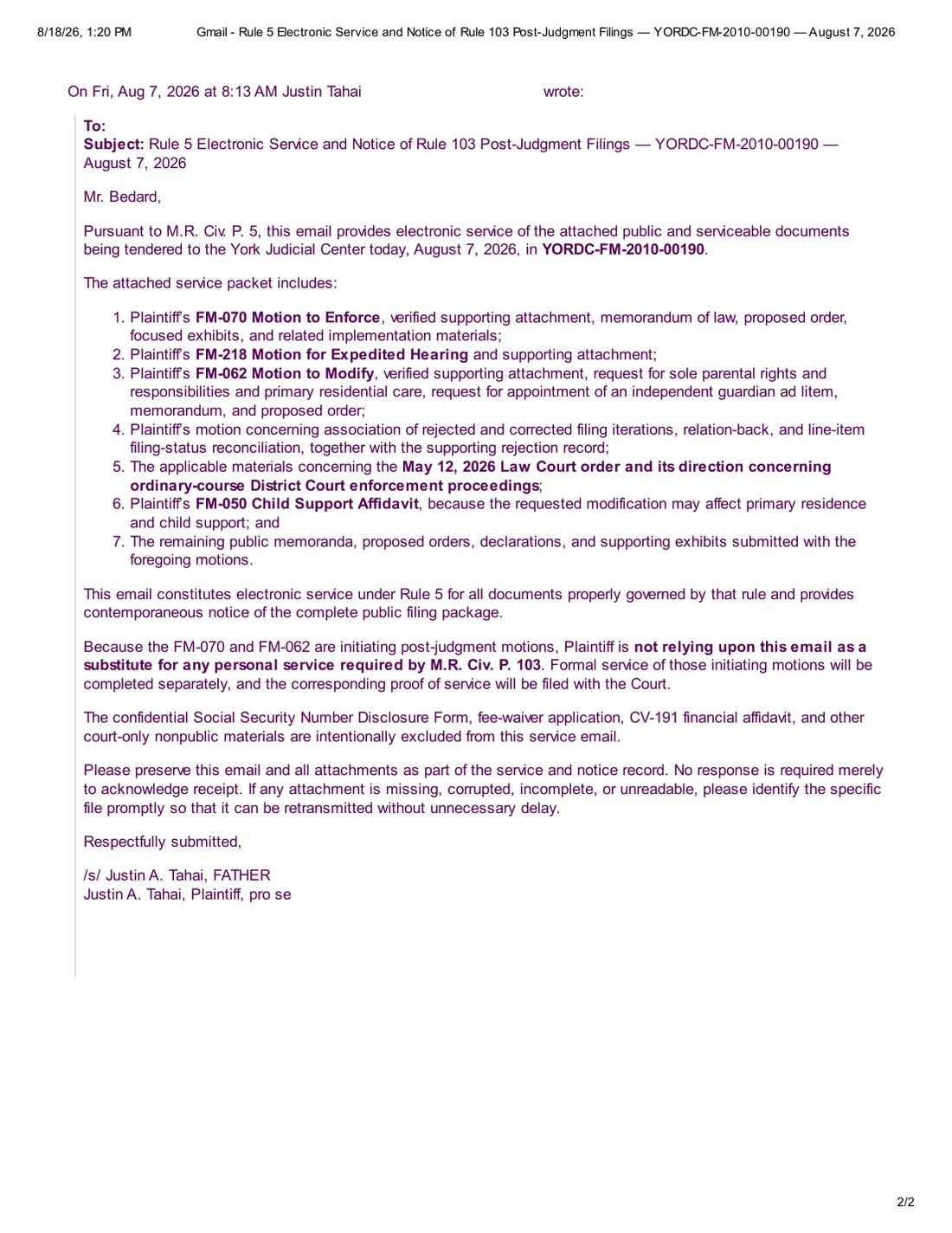
The public-safe email record preserves the exact service posture and the packet list. It distinguishes ordinary Rule 5 electronic service from the separate Rule 103 service required for initiating post-judgment motions.
The public filing packet was emailed to opposing counsel with a statement that initiating motions would receive separate formal service.
The later email states that the packet was tendered at the York Judicial Center and that clerk staff instructed the filer to obtain completed acknowledgments.
Signed CV-FM-036 forms were requested, or a written statement that counsel was not authorized to accept service.
Receipt was not the same as recognized service.
Digital submission was not the same as authoritative filing status.
Hand delivery was not the end of the service question.
The record does not establish that every step was legally unnecessary. It establishes that the public-facing process required the filer to navigate and reconcile several overlapping systems before the court reached the merits.
The order granted meaningful relief in one respect: it preserved the Motion to Enforce, partially granted the fee waiver, and set a defined hearing. It also disposed of the rest of the packet in bulk, added certified-mail service, limited the response obligation, and deferred the merits to October 8.
The order was entered on August 14 after the August 7 packet.
The scheduled hearing date was October 8, producing a 62-day filing-to-hearing interval.
| August 7 packet component | August 14 treatment |
|---|---|
| FM-070 Motion to Enforce | Preserved for hearing |
| Motion to Proceed Without Payment of Fees | Granted in part; enforcement filing fee waived |
| FM-218 Motion for Expedited Hearing | Dismissed under the all-other-documents language |
| FM-062 Motion to Modify | Dismissed under the all-other-documents language |
| Relation-back and filing-status reconciliation motion | Dismissed under the all-other-documents language |
| Other memoranda, proposed orders, declarations, exhibits, and Law Court materials | Dismissed except to the extent incorporated in the surviving filing |
This table maps the contemporaneous email’s packet list against the order’s direction that “all documents” were dismissed except the Motion to Enforce and accompanying fee-waiver motion. The official docket and full filed packet remain controlling.
A true copy of the Motion to Enforce was ordered sent by certified mail, followed by filing the receipt.
The parties were ordered to exchange and file their lists.
Copies of exhibits and any motions in limine were due.
Plaintiff: 8:30–10:00 a.m. Defendant: 10:30 a.m.–12:00 p.m. York Combined Courtroom 8.
The record reflects separate technology, intake, notice, service, and proof-of-service lanes. Each lane may have a legal or operational explanation. The failure is that the filer had to assemble the complete answer across all of them.
Submission, service, rejection, return, correction, and entry messages.
Physical tender at the York Judicial Center.
Contemporaneous electronic notice of the public packet.
CV-FM-036 signature requests after clerk instruction.
Court-directed service of the surviving enforcement motion.
The procedural order stated that some filings were inappropriate and used a footnote to identify a July 28 document by its coarse title.
The public-accountability criticism is not that a court must ignore vulgarity or excuse unprofessional tone. It is that condemning tone does not resolve the underlying implementation, service, docket-status, delay, or merits questions.
A court can admonish the filer and still provide prompt, line-item, operationally usable justice. Those duties are not mutually exclusive.
The separate Tyler Technologies / eFileMaine audit normalizes the Gmail record by message type and representative envelope. It does not treat every automated email as a separate filing.
One envelope can generate multiple submission notices, service notices, rejection notices, File & Serve returns, corrections, and later entry messages. The system architecture multiplies process; the clerk office supplies many of the substantive return reasons; the Judicial Branch controls rules and configuration; and the filer remains responsible for compliance.
Open the full Tyler Technologies / eFileMaine accountability record →
Accurate accountability separates judicial decisions, clerk operations, statewide policy, vendor technology, counsel conduct, and filer obligations.
Scheduling, scope, substantive triage, fee-waiver rulings, dismissal, service orders, hearing allocation, and merits decisions.
Intake, docketing, filing-status communication, service guidance, corrective instructions, receipt handling, and public-facing access.
eCourt procurement, staffing, rules, implementation policy, training, accessibility, metrics, and accountability for systemwide outcomes.
Portal operation, user experience, notification generation, status architecture, technical support, and system-failure messages.
Receipt, acceptance-of-service posture, timely response to the surviving motion, and compliance with operative orders.
Forms, signatures, filing codes, service, document organization, deadlines, factual support, and professional advocacy.
The public copies below remove private home-address, telephone, email, and Gmail-account information. The native originals and official docket remain controlling.
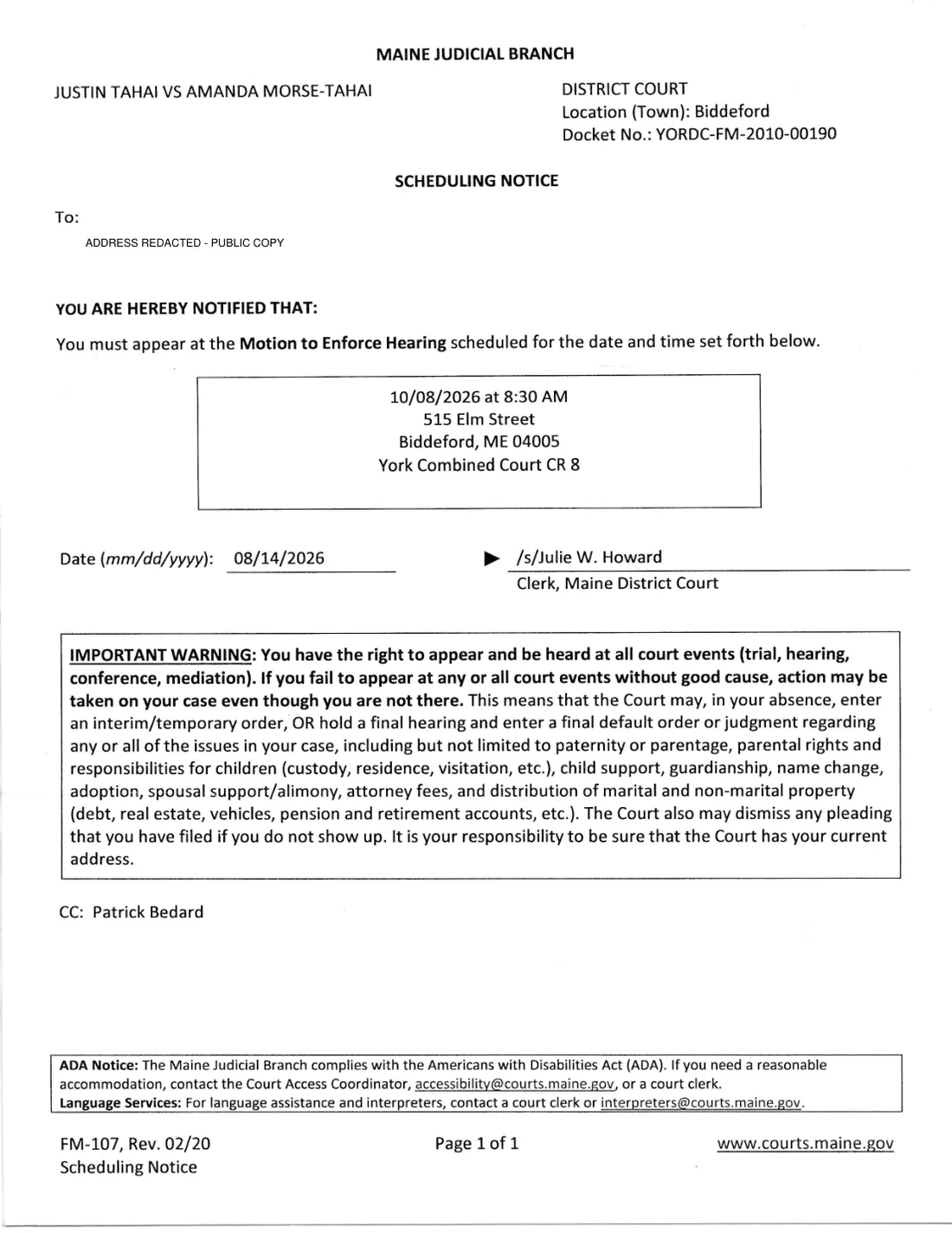
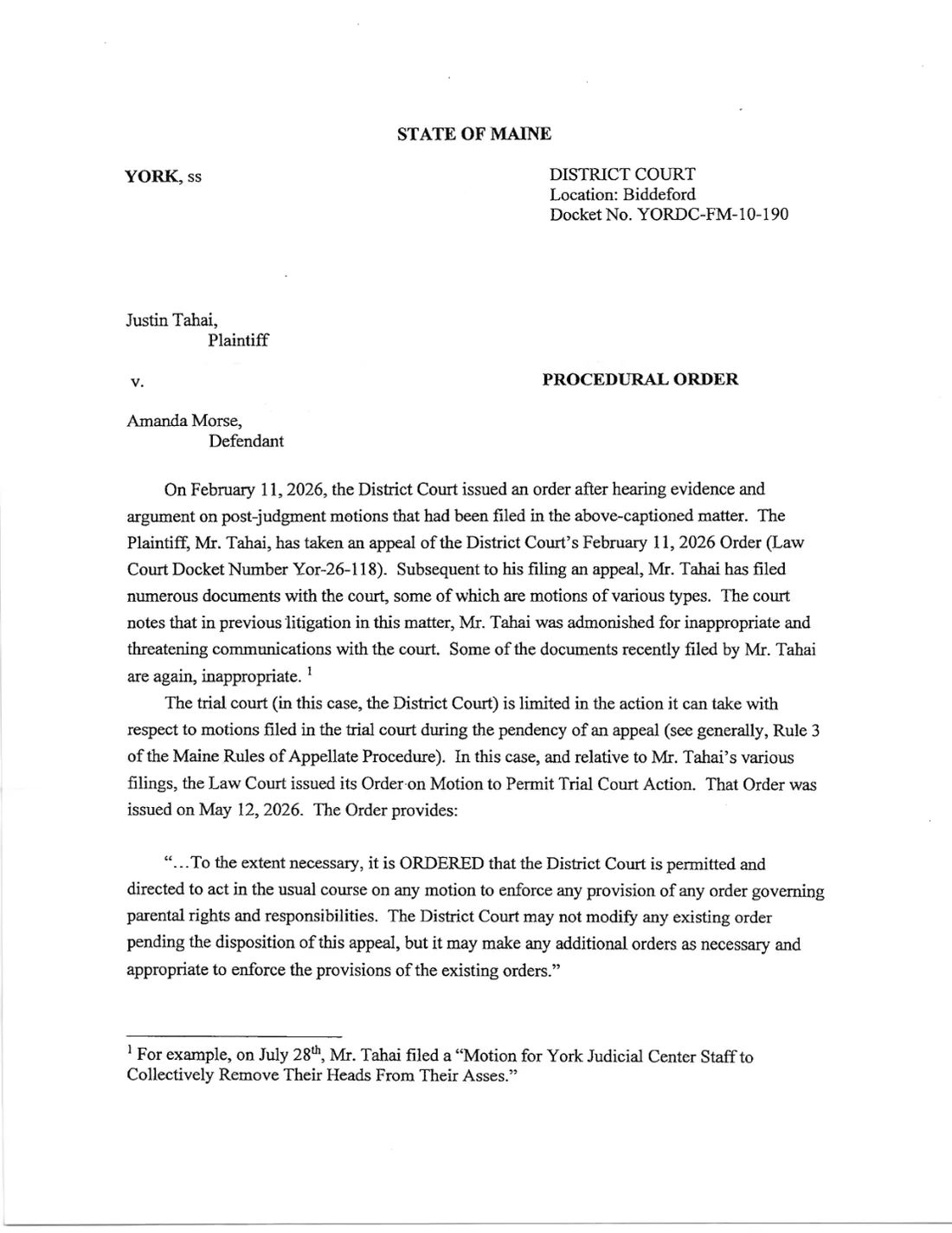
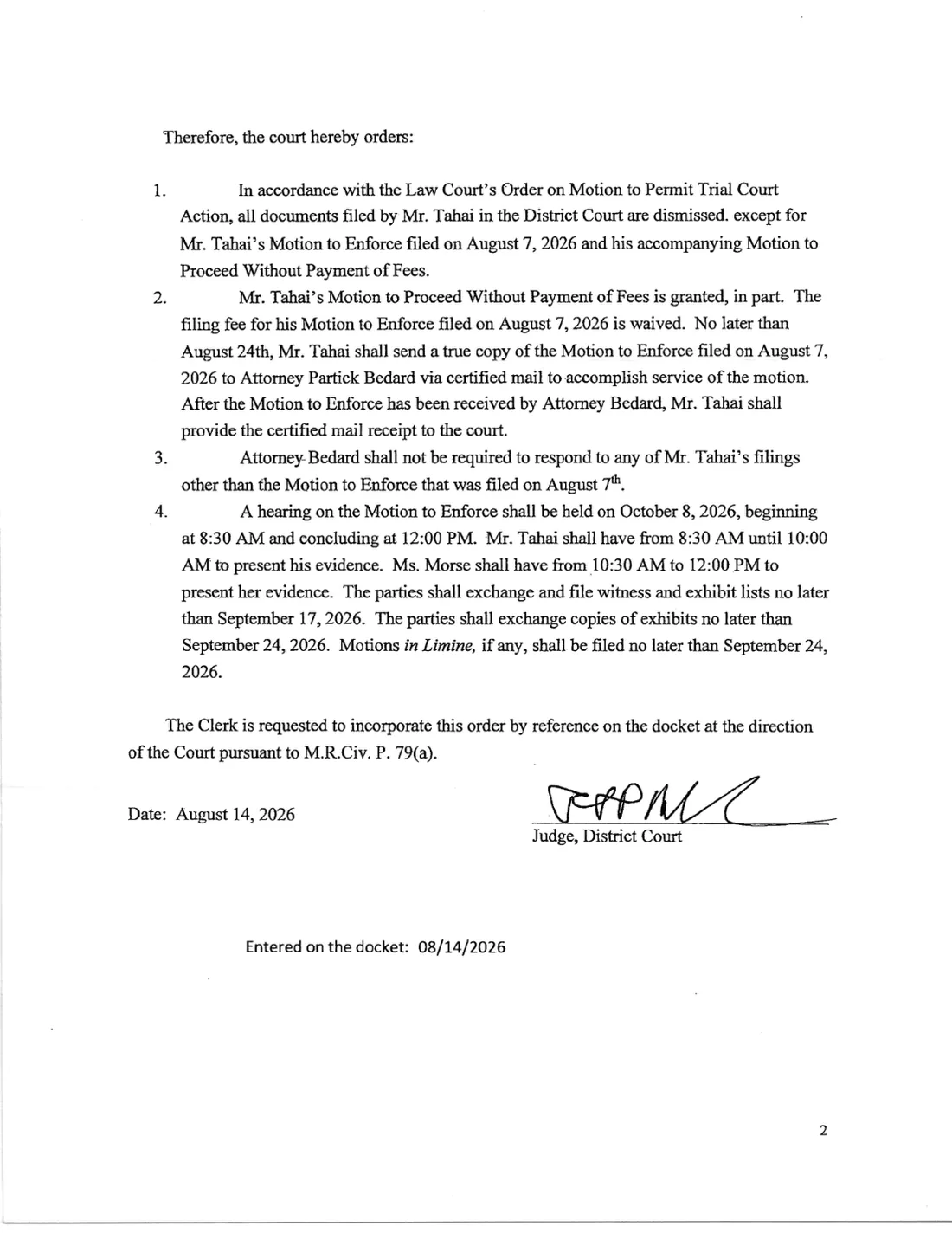
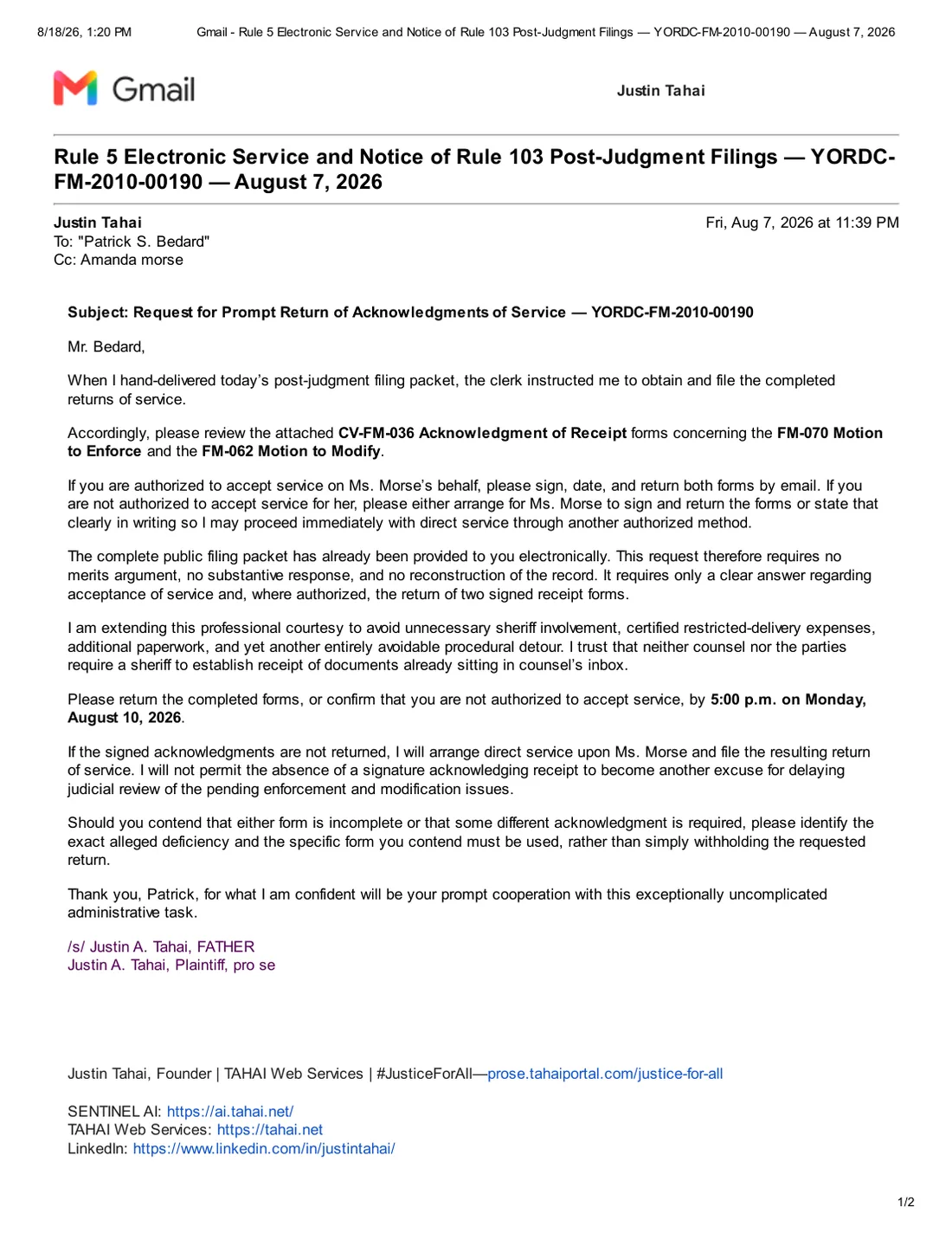
Six-page packet: public-safe Rule 5 / Rule 103 service record followed by the public-safe scheduling notice and procedural order.
Download packetThree-page public-safe source copy.
Open PDFTwo-page public-safe email record with exact timestamps.
Open PDFPortable summary of dates, order treatment, metrics, limitations, and requested repairs.
Open textMachine-readable metrics, event ledger, packet map, sources, and limitations.
Open JSONMessage-level and envelope-normalized filing-system record.
Open recordSigned orders, open letter, nonpresentment issue, and Rule 10(c) referral record.
Open recordThe Maine Judicial Branch, York Judicial Center, Tyler Technologies, counsel, or any directly discussed participant may identify a specific factual statement, the source relied upon, and the exact correction requested. Source-supported corrections will be logged. A disagreement with the public-accountability conclusion will not be mislabeled as a factual correction.
This external review was authored by Justin Tahai and is hosted by Google. It is opinion, not a judicial finding. Do not use the link to coordinate contact, harassment, or review-bombing.
Public boundary: JTforME separates public records, official data, party positions, public-policy argument, allegations, inferences, corrections, and adverse material by type. A complaint, referral, review, or public statement is not an adjudicated finding. Do not send child names, sealed records, medical details, private allegations, or confidential files through public campaign links. Do not contact, threaten, shame, surveil, pressure, or review-bomb a private person.