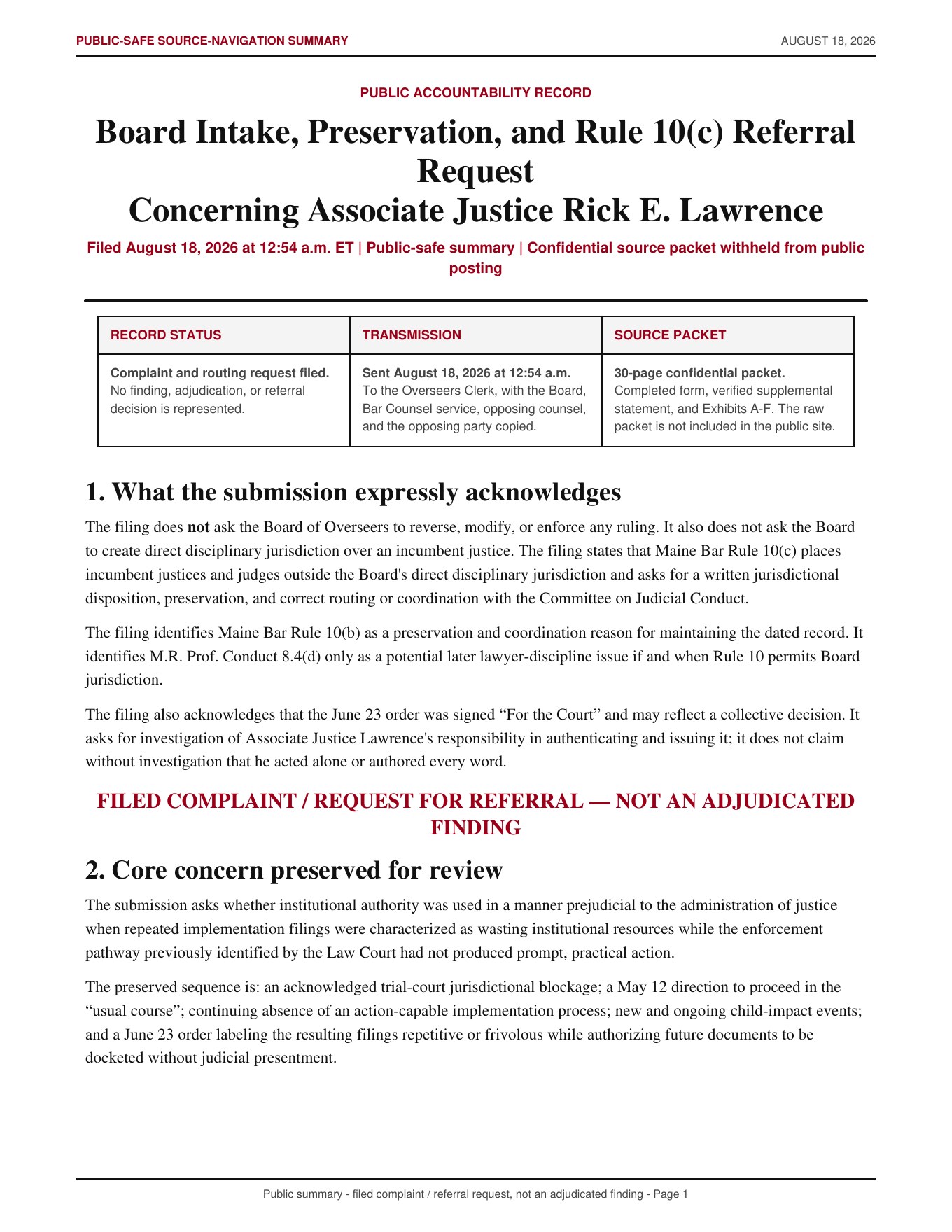
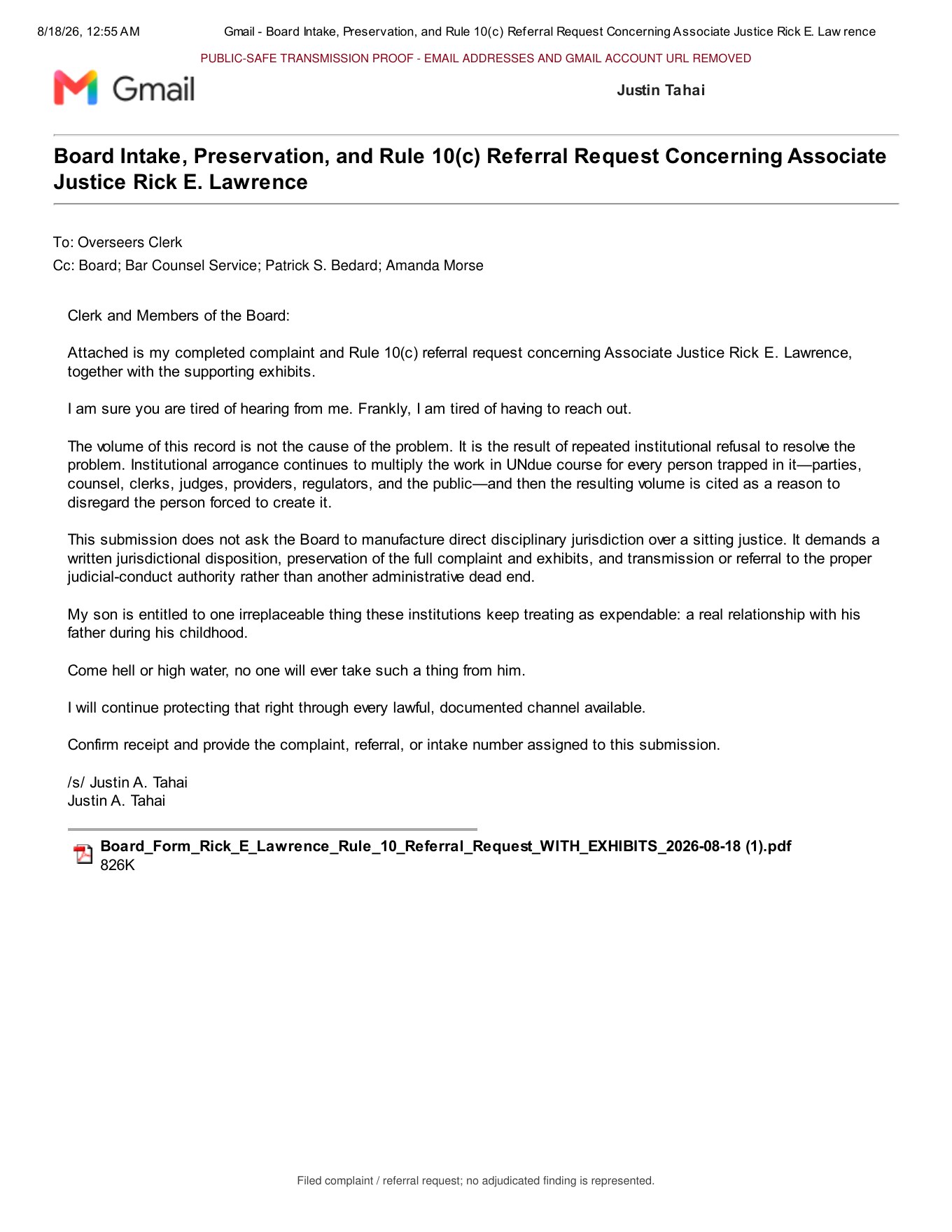
I am writing directly to you, through the Executive Clerk and with simultaneous distribution to the opposing party, counsel, the Administrative Office of the Courts, the Maine Attorney General, Judge John B. Lucy, Sr., members of the press, and other public-accountability recipients, because the May 12, 2026 Law Court order has not been made real in my son's life.
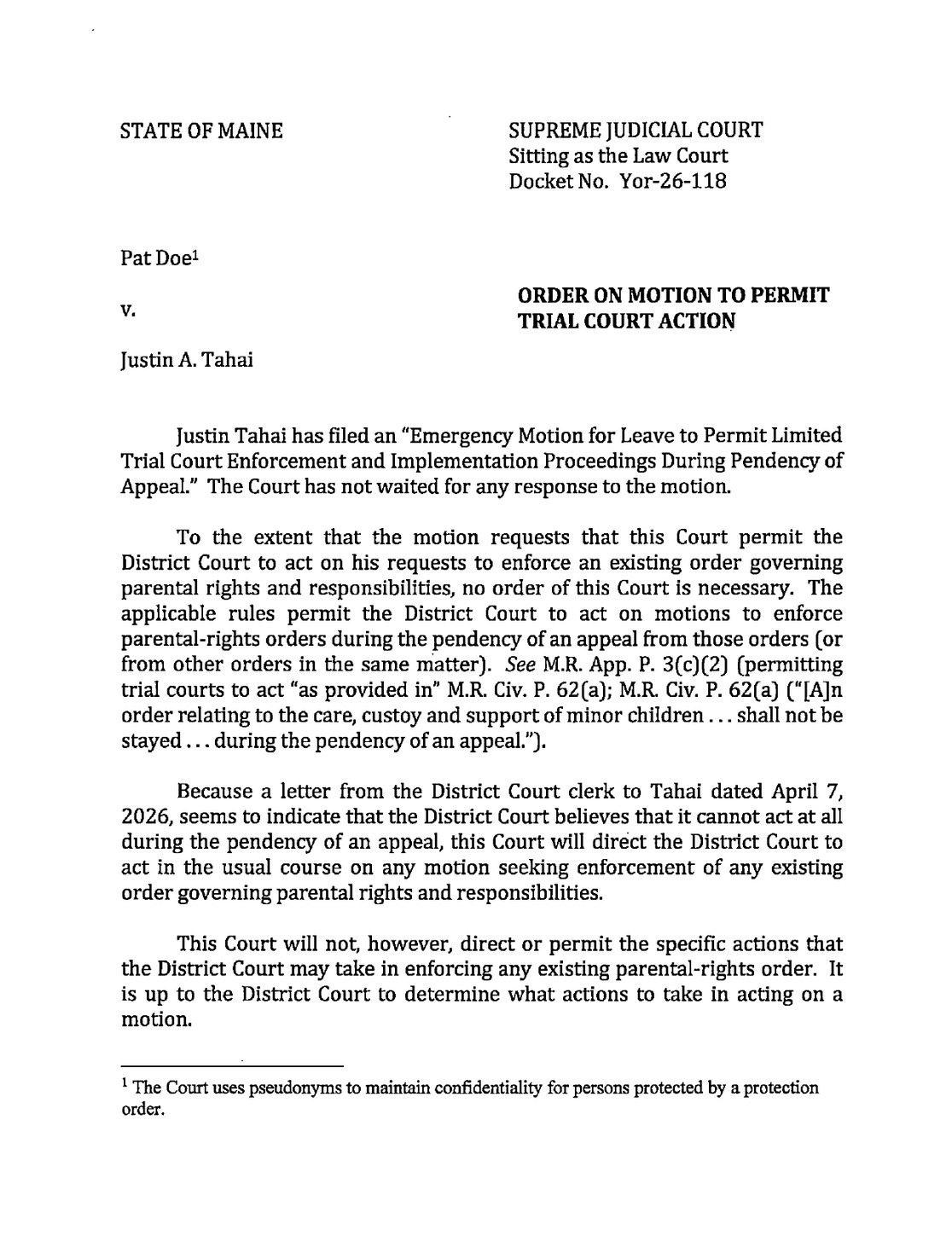
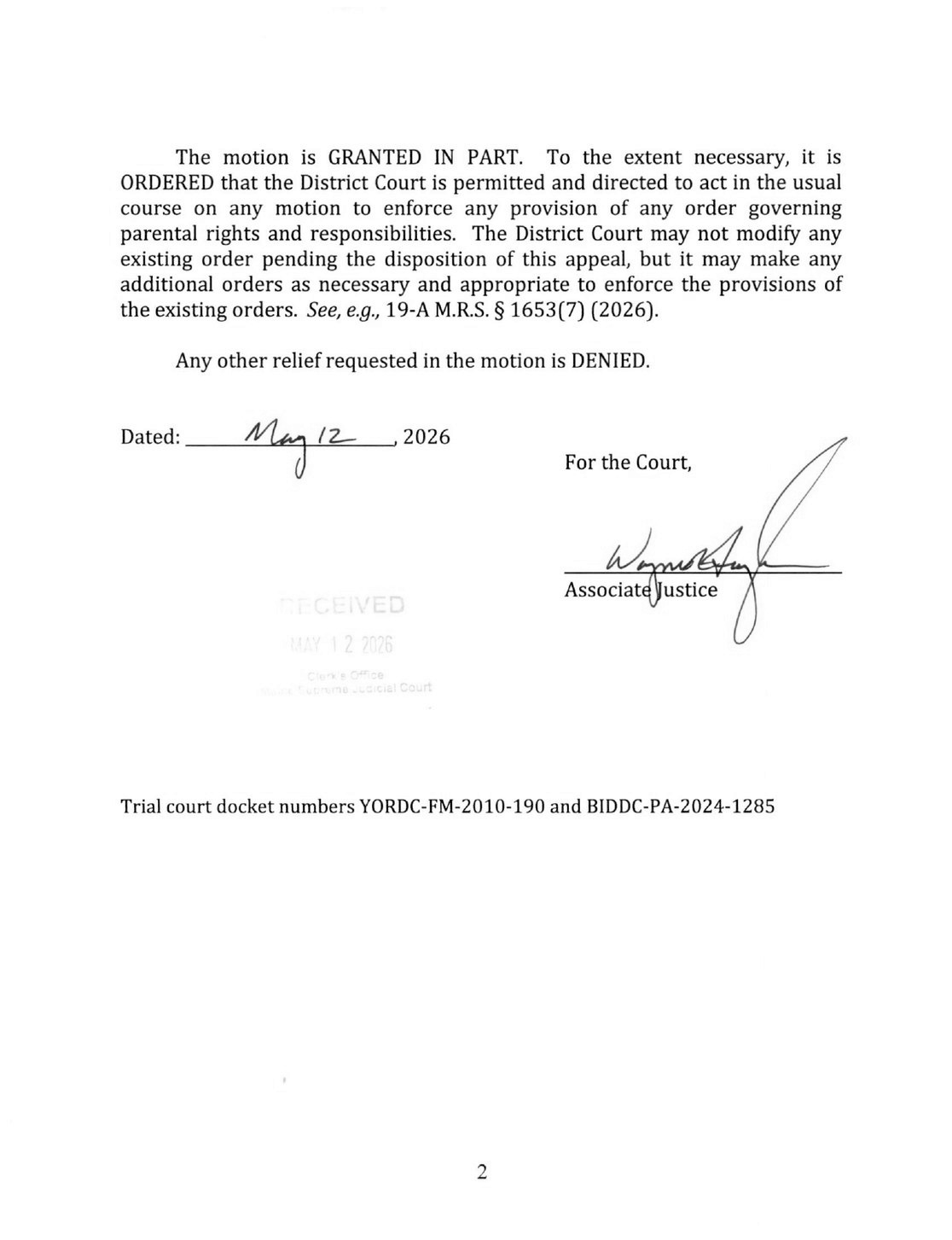
This is not a request for secret access, private consideration, or an ex parte ruling. I do not contend that disputed allegations should be accepted as established facts without a hearing. I am demanding institutional accountability for what has happened after an order of the Law Court stated that the District Court possessed sufficient authority to act in the usual course on post-judgment contempt and enforcement matters.
That ruling was supposed to preserve an action-capable path while the appeal remained pending.
Instead, ninety-seven days have now passed since May 12, 2026. One hundred eighty-seven days have passed since the February 11, 2026 order. The practical implementation of parent-child contact, reunification therapy, medical and school access, adult coordination, and basic records access remains disputed, irregular, or unresolved.
I KNEW THIS WOULD HAPPEN.
THAT IS WHY I FILED THE EMERGENCY MOTIONS.
I did not file them because I enjoy litigation. I did not file them because I failed to understand that appellate courts ordinarily review records rather than manage daily family logistics. I filed them because nearly sixteen years in this system taught me exactly what would happen if implementation were left ambiguous, discretionary, and dependent upon the voluntary cooperation of the people benefiting from delay.
I knew that every undefined responsibility would become another argument.
I knew that every absence of a deadline would become more lost time.
I knew that language requiring consideration of my son's schedule and desires would be distorted into a claim that a child was the 'sole gatekeeper' of whether a court-ordered relationship could exist at all.
I knew that Ms. Morse and Attorney Bedard would continue shifting adult implementation responsibility onto my son while avoiding a clear adult position, a stable schedule, and meaningful accountability.
I knew that an order recognizing parental rights could be made functionally meaningless if no institution required the adults to implement it.
And I told the courts all of this in good faith.
Within days of the February 11 order, I demanded the basic information necessary to make it function: a telephone number and platform for electronic contact, a dependable contact window, therapy and transportation logistics, a concrete path for in-person contact, medical and school information, insurance information, and necessary records authorizations.
Those were not extraordinary demands. They were not an attempt to relitigate the final hearing. They were the ordinary operational details required to turn a written order into an actual parent-child relationship.
The responses and subsequent conduct documented in the record did not produce that implementation.
Attorney Bedard later stated, in substance, that Ms. Morse would not respond to every communication, that she would provide information when she determined she 'needed to,' that I should independently pursue school and medical information, and that Ms. Morse and counsel would review my compliance before in-person contact could proceed.
Ms. Morse then expressly described our son as the 'sole gatekeeper' of contact and stated that in-person contact would be 'solely his decision.' When I challenged that interpretation, she stated that it was not merely her interpretation but supposedly 'verbatim.' She also threatened to characterize ordinary non-emergency child-related communications as protection-order violations.
THAT WAS PRECISELY THE ADULT IMPLEMENTATION FAILURE I WARNED THE COURTS ABOUT.
A teenager's feelings, schedule, and comfort matter. They must be heard and supported. But a child cannot be made responsible for interpreting judicial orders, deciding whether they will be implemented, carrying adult accusations between parents, or policing the lawful parental participation that the adults and courts refuse to clarify.
That is not respecting a child.
It is burdening him with the work the adults have refused to perform.
The problem continued through counseling logistics, school access, attendance concerns, medical information, and direct parent-provider access. On August 3, 2026, the conflict reached another predictable endpoint at my son's annual physical. My son telephoned me from the medical office and stated that he was 'pretty sure' I was not supposed to be there and told me to leave. I did not enter the examination room or create a confrontation. I remained in the waiting area and immediately documented the incident through the permitted adult channels.
The current record does not yet establish who told him that, precisely what was said, or why he believed it. That requires evidence. But the event itself demonstrates the institutional failure: my sixteen-year-old son was again placed in the position of attempting to interpret and enforce an adult legal restriction concerning his father's participation in his healthcare.
That should never have been his burden.
I then attempted to place the August 3 evidence and related enforcement materials before the District Court. Those submissions entered another electronic-filing rejection cycle. The merits were not reached. The child-impact problem was again converted into paperwork, corrective submissions, proposed orders, service notices, and administrative delay.
THIS IS WHAT INSTITUTIONAL ARROGANCE LOOKS LIKE IN PRACTICE.
It is the assumption that an order has protected a child merely because a justice signed it.
It is the assumption that a remedy exists merely because a rule theoretically permits a motion.
It is the assumption that 'ordinary course' is adequate even when the ordinary course consumes months of an irreplaceable childhood.
It is the willingness to treat rejected filings, opaque dismissal entries, recusal, record fragmentation, and repeated refiling as neutral procedural events while the same parent-child deprivation continues outside the courthouse.
They are not neutral.
A CHILD CANNOT HAVE A RELATIONSHIP WITH A PDF.
He cannot recover a missed day, holiday, school year, conversation, therapy session, medical appointment, or opportunity to trust both parents because a later order eventually explains what should have happened.
No later ruling can restore the time taken.
No appellate opinion can return my son to an earlier stage of childhood.
No finding issued after he becomes an adult can repair the full developmental cost of allowing temporary obstruction and institutional hesitation to harden into the only reality he knows.
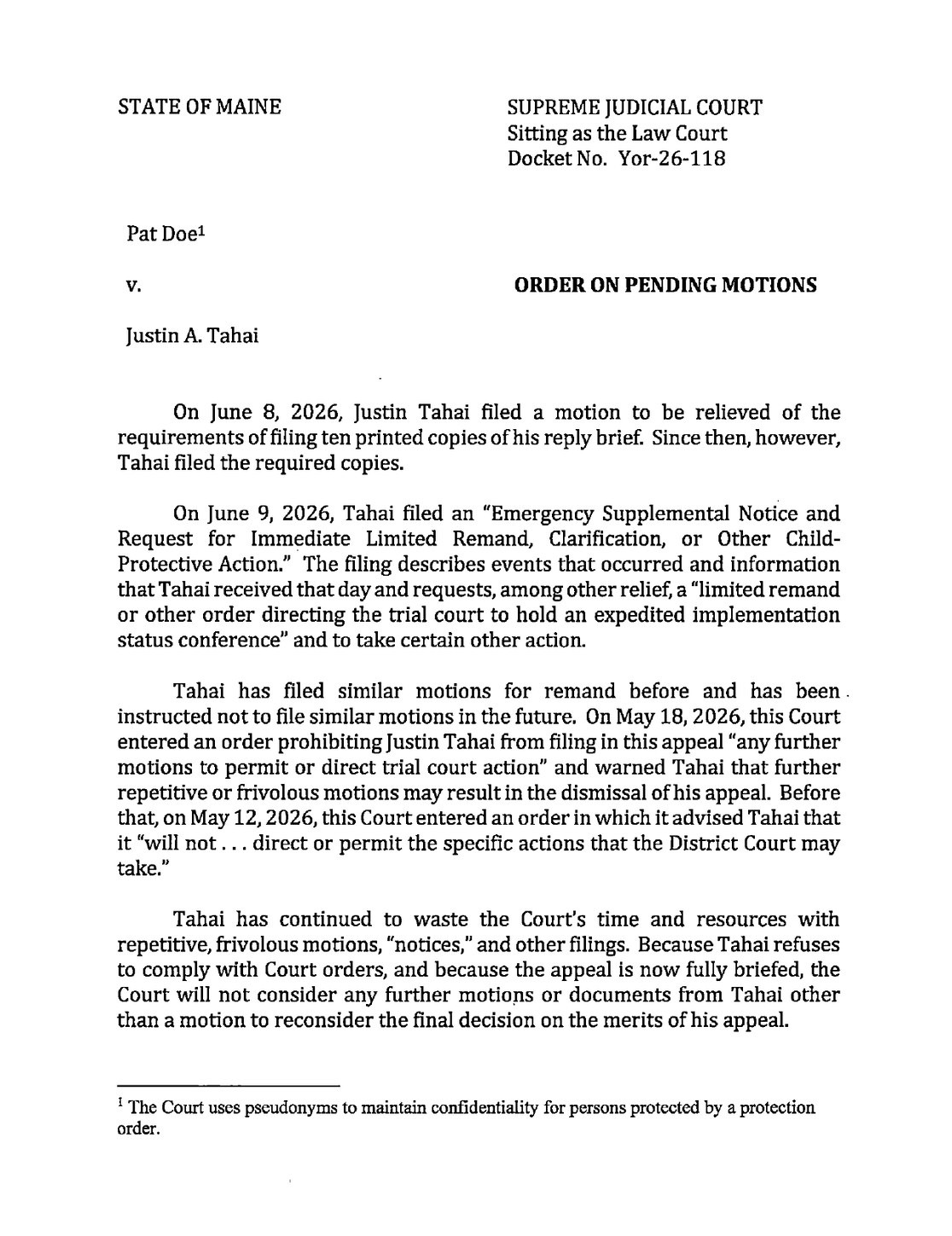
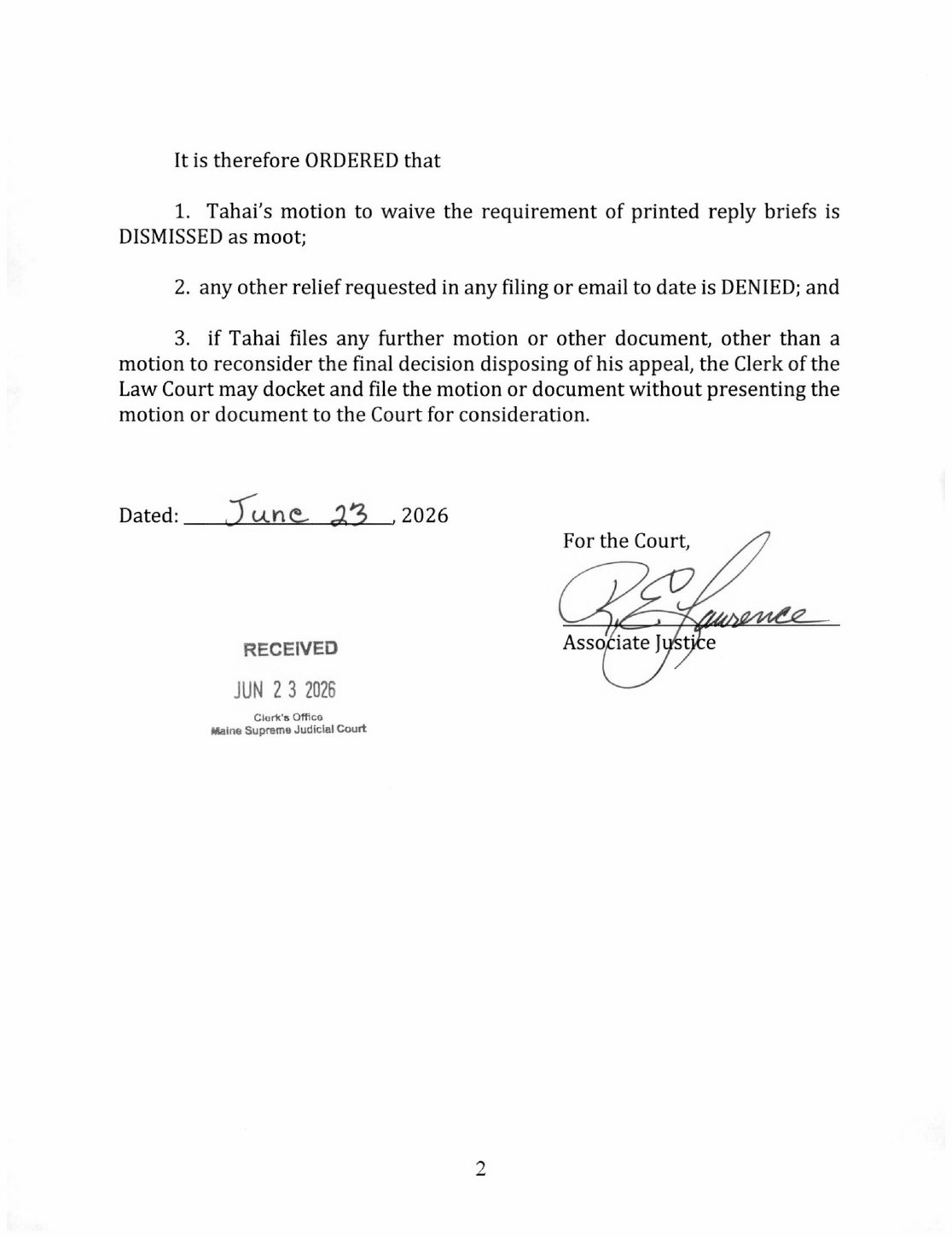
For nearly sixteen years, these courts have been informed in good faith about recurring access obstruction, records problems, disparagement concerns, therapy delays, school instability, adult gatekeeping, and damage to the parent-child relationship. I repeatedly used the processes the courts directed me to use. I filed motions. I demanded hearings. I sought clarification. I moved for expedited consideration. I sought an electronic recording when I could not afford the transcript. I complied with correction notices. I served opposing counsel. I returned to the trial court after the Law Court said that court retained enforcement authority.
THE RESULT IS STILL DRIFT.
THE RESULT IS STILL ANOTHER MOTION.
THE RESULT IS STILL ANOTHER REJECTION.
THE RESULT IS STILL ANOTHER MONTH OF MY SON'S LIFE.
I therefore demand the following institutional action:
- Docket or otherwise formally preserve this non-ex parte public notice in connection with Yor-26-118, with confirmation that it was received and distributed to all listed recipients.
- Clarify, to the extent necessary and legally permissible, that the May 12 order contemplated actual, timely trial-court consideration of post-judgment enforcement and contempt matters - not indefinite administrative processing while the underlying child-impact conditions continued.
- Use every lawful appellate or administrative authority available to prevent the May 12 order from being rendered practically meaningless through unexplained dismissal entries, serial electronic-filing barriers, recusal-related drift, or the absence of an identifiable action-capable judicial path.
- At minimum, provide a concrete written answer identifying the present lawful mechanism, tribunal, and filing posture through which the continuing implementation issues will receive a prompt evidentiary hearing without requiring me to restart the entire sixteen-year history yet again.
I am angry because this harm was foreseeable.
I was explicit about it.
The emergency motions existed because I knew silence, delay, procedural deference, and institutional self-protection would again be mistaken for neutrality. They were not neutral. Each day of inaction benefited the existing obstruction and cost my son another day of his relationship with his father.
Every court involved has trained lawyers, clerks, administrators, and institutional authority.
MY SON HAS ONLY ONE CHILDHOOD.
STOP TREATING THE LOSS OF THAT CHILDHOOD AS ADMINISTRATIVELY TOLERABLE.
STOP ALLOWING ADULTS TO TRANSFER IMPLEMENTATION RESPONSIBILITY ONTO MY SON.
STOP ALLOWING A STANDING PARENT-CHILD ORDER TO FUNCTION AS A SUGGESTION.
STOP HARMING MY SON.
Submitted,
/s/ Justin A. Tahai
Justin A. Tahai, Father and Appellant, pro se
Public posting copy - private contact details omitted.
Copy and public distribution
This open letter is intended for simultaneous email distribution and public posting. It is not a private or ex parte communication, and no recipient is represented as having endorsed its contents merely by receiving it.
| Distribution lane | Recipient / destination |
|---|
| Primary addressee | Associate Justice Rick E. Lawrence, Maine Supreme Judicial Court, through the Executive Clerk / Clerk of the Law Court |
| Judicial administration | Administrative Office of the Courts, Maine Judicial Branch |
| State legal office | Office of the Maine Attorney General |
| Trial-court copy | John B. Lucy, Sr., Maine District Court |
| Opposing counsel | Patrick S. Bedard, Esq. |
| Opposing party | Amanda Morse |
| Public accountability | Members of the press, public officials, oversight recipients, and other media/public-accountability recipients included in the transmitting email |
| Public posting | JTforME.com campaign and public-accountability site |
Public-record discipline
This letter states the author's position and account of the documented implementation history. Disputed facts remain subject to evidence and adjudication. The letter does not claim that every recipient has agreed with, adopted, or acted upon its contents.