Safety firstIf there is immediate danger, someone may be harmed, or you may not stay safe, call 911 now.For emotional crisis, call or text 988, or call the Maine Crisis Line at 1-888-568-1112. If abuse, coercive control, stalking, sexual assault, or child-safety concerns are involved, use the crisis page before forms, arguments, or public-record work.Safe-device reminder: if another person monitors this device, use a safer phone/computer, clear history only if safe, or call a live advocate.
No private case intake: do not send child names, sealed records, private allegations, or confidential files through public campaign links. Privacy boundarySafety first
Site boundary: JTforME is the campaign, public-record, citizen-initiative, and Maine family-help routing hub. For volunteer-only public education, printable tools, and research/source materials, use FOCaF.
Independent public record · Maine attorney discipline · source-linked review
Maine Board of Overseers of the Bar — Accountability Record
This independent page compares the grievance that was submitted, the disposition that followed, and the Maine Bar Rules governing investigation and public-member review.
It separates complainant allegations, Board correspondence, governing rules, and public commentary. It does not claim a disciplinary finding and does not ask readers to accept a summary without opening the linked documents.
Central record conflictThe May 2026 filing described GCF 26-240 as a new and materially different grievance focused on continuing conduct. The July 21 dismissal characterized the requested review as re-litigation of underlying cases. The documents below allow readers to compare those descriptions directly.Compare the records
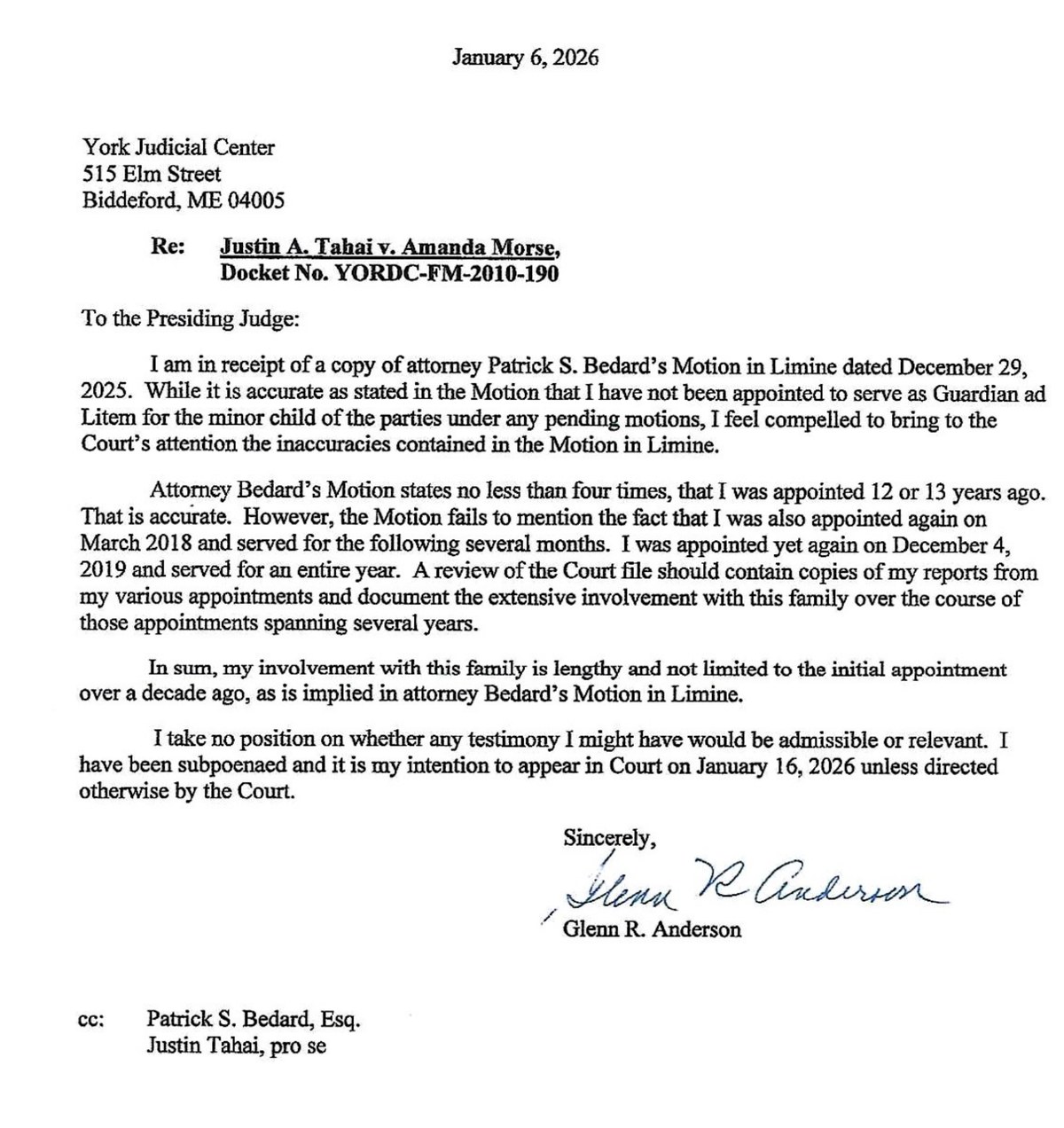
Named direct source: the May 25 packet asked the Board to consider Glenn R. Anderson, Esq. His January 6, 2026 letter told the presiding judge that a Patrick S. Bedard motion contained “inaccuracies” and omitted later GAL appointments.
Open this source lane
Private review ZIP not publishedHome and child data excludedAllegations labeledNo misconduct finding claimedCorrection path open
New in V46R1
New August 21 objection analysis
The new source-controlled narrative separates adverse advocacy from potential rules issues, identifies what would require proof of knowledge, and keeps basic human decency distinct from disciplinary doctrine.
V56 polished institutional satire · keyboard, touch, mouse, or fullscreen
The Board of Overseers now has an Accountability Laundromat.
Catch the specific claim, native source, exact date, witness, governing rule, contrary record, source comparison, written reasons, and right of reply. Dodge the generic denial, rubber stamp, no-interview shortcut, scope swap, unread source, and untraceable disposition. Then lock all three loads inside the green full-cycle zone.
The Accountability LaundromatJavaScript is required for this optional editorial game. Every linked document, governing rule, limitation, and correction path remains available without it.
Boundary: “Laundromat” and “whitewash” are plainly labeled institutional metaphors. The game does not claim that any Board employee or reviewer literally launders complaints, establish an ethics violation, or substitute satire for the complaint, disposition, rules, source documents, contrary material, or public-member review record.
The main issue
Two grievance records were not presented as interchangeable.
The May 2026 packet described the earlier GCF-25-524 matter, then expressly presented GCF 26-240 as a new complaint based on post-dismissal and continuing conduct. The public-accountability issue is whether the July 21 disposition analyzed that new scope on its own terms.
Earlier matter
GCF-25-524
The May 25 packet described the prior grievance as raising earlier allegations involving unsupported factual assertions, procedure, implementation friction, and record-shaping through the earlier record.
Public question:
What was investigated and decided in that earlier file, and what remained outside it?
New filing
GCF 26-240
The May 15 complaint, May 25 official form, and supplemental addendum said the new filing concerned post-dismissal and continuing conduct, including events after the February 11 order, with additional implementation, records-access, counseling, school, filing, and appellate-record issues.
Express request:
“Open and maintain matter 26-240 as a new grievance, not merely an administrative supplement to the prior dismissed matter.”
Express scope limitation
“I am not asking the Board to decide custody, parenting time, child support, the pending appeals, or any merits issue reserved to a court.”
The July 21 dismissal acknowledged that written limitation and then stated that re-litigation was nevertheless the action sought.
Face-of-record comparison
The complaint and dismissal describe different requests.
Characterized the request as re-litigation of PFA and family matters.
How did the express limitation become a re-litigation request?
Attorney conduct
Counsel-specific candor, fairness, record-shaping, implementation, and procedural-conduct theories.
Primarily framed the submission as blame for the client’s conduct and an effort to impute it to counsel.
Which counsel-specific allegations were separately analyzed?
Evidence
A 39-page packet, source maps, timelines, filings, service records, named witnesses, and an offer of native materials.
Did not identify which attachments, pages, source records, or witnesses were reviewed.
What was opened, requested, contacted, or verified?
Investigation
Requested substantial investigation, native-source review, and consideration of Glenn Anderson and Daniel Pierce.
Used the term “grievance investigation” but did not describe investigative steps in the dismissal letter.
What occurred beyond paper review and characterization?
This comparison does not prove motive or misconduct. It identifies a visible source conflict that warrants an accurate, independent explanation.
The direct source the complaint identified
Glenn Anderson’s January 6 letter belongs in the center of the review.
Anderson wrote directly to the presiding judge after reviewing Bedard’s December 29, 2025 Motion in Limine. He said he felt compelled to bring “the inaccuracies contained in the Motion in Limine” to the court’s attention.
He identified omitted later appointments in 2018 and 2019 and rejected the implication that his involvement was limited to an appointment more than a decade earlier.
Board-accountability question
The 26-240 packet named Anderson as a witness or source. Was he contacted? Was the January 6 letter reviewed? Was Bedard asked to explain the factual basis for the motion and any correction made after the letter?
Direct court correspondence. Bedard was copied. The letter is not itself a disciplinary finding.
What the public record does and does not show
The dismissal says an investigation occurred. The letter does not identify the steps.
Visible in the supplied record
May 25 submission of the official form and incorporated 39-page packet.
July 8 acknowledgment instructing the complainant not to send more material while review was pending.
July 21 dismissal stating that the May 25 complaint was reviewed.
A conclusion that the record did not establish a professional-conduct violation.
Not identified in the dismissal letter
Documents and pages opened or relied upon.
Any request for native emails, source records, or audit history.
Contact with Anderson, Pierce, or another identified source.
A response from Bedard or whether one was requested.
A rule-by-rule analysis of the counsel-specific allegations.
The origin of the re-litigation characterization.
The absence of those details from a short dismissal letter does not establish that no internal work occurred. It does establish that the public-facing disposition does not make that work independently verifiable.
The Board’s own published standards
Public accountability starts with the rules the institution administers.
Institution
Created by the Maine Supreme Judicial Court
The Judicial Branch describes the Board as the body created to regulate lawyer conduct, enforce the Maine Bar Rules and Rules of Professional Conduct, and appoint Bar Counsel and the Grievance Commission.
Rules require investigation and a reasoned disposition
Current published Rule 13 provides that Bar Counsel conducts investigations when allegations, if true, could constitute misconduct and states that reasons for a disposition must be given in writing.
Complaints involving Bar Counsel staff require separate routing
The Board’s published rules provide special routing or independent authority when a complaint concerns an attorney employed in the office of Bar Counsel, Bar Counsel, the Board Clerk, or a Board member.
Current official text controls. The Board’s website contains current and legacy numbering in different rule pages. This page links to the official sources and does not substitute for them.
Status and independent review
The next test is whether review is genuinely independent and record-specific.
July 21
Dismissal issued
The letter dismissed GCF 26-240 and advised that a written request for public-member review could be made within 21 days.
July 24 packet
Public-member review request prepared
The supplied private-review packet contains a dated, unequivocal request invoking public non-attorney review. This page does not claim transmission confirmation that has not been published.
Separate issue
Prendergast conduct grievance prepared
The packet also contains a separate draft grievance and preservation demand focused on the alleged material recasting of GCF 26-240. That draft is not published here as a filed or decided matter.
Changing only the reviewer’s name is not enough.
Meaningful independence requires a reviewer who did not participate in the first disposition, access to the complete native record, a line-by-line comparison, preservation of drafts and audit history, and a written explanation that addresses the actual allegations rather than a simplified substitute.
Public-safe verification set
Open the underlying documents before accepting anyone’s summary.
Complainant submission
May 15, 2026 new complaint
Public-redacted nine-page submission presenting GCF 26-240 as a new post-dismissal grievance. It expressly excludes custody, parenting-time, and appellate-merits adjudication. Allegations are not findings.
Board letter acknowledging July communications and instructing the complainant not to submit additional information while review was pending. Home address removed.
The complete 39-page packet is not published because it contains home and contact information, date of birth, child and school/provider details, and extensive family-court material. The page instead links public-redacted primary submissions and a public-safe verification set.
Related commentary — not evidence
Broader reform context, clearly separated from the grievance record.
Articles & Public Commentary
The complete commentary archive keeps public-policy argument, research-backed analysis, satire, and first-person perspective in a separate lane from Board correspondence and grievance evidence.
From the Founding Fathers to Family Court: Revolution Without Open Revolt
Justin Tahai’s LinkedIn commentary places the accountability work in a broader civic-reform frame. It is advocacy and opinion, not Board correspondence, evidence in GCF 26-240, or a disciplinary finding.
A regulator should be able to show these six things.
Accurate intake: describe the complaint that was filed, not a simpler complaint that is easier to dismiss.
Distinct matters: explain why a newer grievance is or is not materially different from an earlier one.
Evidence traceability: identify the documents, pages, sources, and witness requests actually considered.
Investigative integrity: distinguish paper review from source verification, witness contact, respondent response, or other investigative work.
Independent routing: keep complaints about the regulator’s own staff out of the original decision chain.
Reasoned notice: provide enough explanation for a public member, court, attorney, complainant, and public reader to understand the disposition.
Right of reply and correction
The Board, its staff, and every person named may answer the record.
Corrections are invited by exact sentence and source. A response may identify documents reviewed, investigative steps taken, the factual basis for treating the matter as re-litigation, the distinction drawn between GCF-25-524 and 26-240, or any material fact this page states incorrectly.
This page will distinguish a documented correction from a disagreement over interpretation. It will not present a complaint, dismissal, or public criticism as a misconduct finding that does not exist.
No adverse inference is drawn from silence, disagreement, or the brevity of a disposition. The page asks only that material record conflicts be answered with the complete record and the applicable rules.
This external review was authored by Justin Tahai and is hosted by Google. It is opinion, not a Board disposition or disciplinary finding. Do not use the link to coordinate contact, harassment, or review-bombing.
Public boundary: JTforME separates public records, official data, party positions, public-policy argument, allegations, inferences, corrections, and adverse material by type. A complaint, referral, review, or public statement is not an adjudicated finding. Do not send child names, sealed records, medical details, private allegations, or confidential files through public campaign links. Do not contact, threaten, shame, surveil, pressure, or review-bomb a private person.